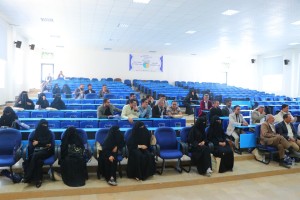
PhD Degree Awarded to Mr. Abdulsalam Mohammed Hussein in Information Technology

Mr. Abdulsalam Mohammed Hussein Khaqo was awarded a PhD degree in Information Technology for his dissertation titled: Enhancing Asynchronous Advantage Actor-Critic Algorithm for Cybersecurity Intrusion Detection in Edge Computing, which was submitted to the Faculty of Computer and Information Technology – Sana’a University. The dissertation defense was held on Thursday, February 12, 2026.

The PhD Viva-Voce Committee, which was formed based on a resolution issued by the Graduate Studies and Scientific Research Council, consisted of the following:
| # | Committee Members | Designation | Position |
| 1 | Assoc. Prof. Naji Ali Abdullah Al-Shaibani | Internal Examiner | Chair |
| 2 | Prof. Sharaf Abdulhaq Mahyoub Al-Hamdi | Main Supervisor | Member |
| 3 | Assoc. Prof. Fouad Hassan Mohammed Yahya Abdulrazzaq | External Examiner | Member |
The dissertation aimed to:
- Develop adaptive class balancing using Dynamic Synthetic Minority Oversampling combined with Edited Nearest Neighbors (DSMOTEENN) on the X-IIoTID
- Enhance the Worker component in the A3C algorithm to achieve faster convergence, reduced gradient variance, stable updates, and improved parameter
- Design the hybrid HADT algorithm integrating the enhanced A3C (suitable for continuous-feature attack detection) with Decision Tree (DT) classifiers (effective for discrete-feature attacks).
The study yielded several key findings summarized as follows:
- The hybrid model effectively addressed data imbalance using DSMOTEENN, improving rare-class detection and reducing error rates.
- The proposed enhancements to A3C within the EA3C model (including gradient stabilization, weighted synchronization, and CNN/FFNN-based feature extraction) achieved faster convergence, greater training stability, and superior generalization compared to baseline models such as DT, DDQN, and AERL.
- The HADT algorithm achieved outstanding performance in Industrial IoT intrusion detection, with average Accuracy, Precision, Recall, and F1-Score exceeding 8% in both binary and multi-class classification (up to 19 attack classes).
- ROC and AUC analyses showed near-perfect discrimination (0.9982–1.0000).
- The model demonstrated computational efficiency with reduced training time, suitable inference latency, and optimized energy consumption—making it appropriate for resource-constrained edge computing environments.
- The proposed hybrid methodology outperformed traditional and standalone reinforcement learning approaches, establishing a new benchmark in Industrial IoT cybersecurity analytics.
In light of these findings, the researcher recommended the following:
- Expanding evaluation across diverse industrial datasets (energy, manufacturing, healthcare) to validate generalizability.
- Integrating graph-based deep learning models (e.g., Graph Neural Networks and Graph Attention Networks) for detecting coordinated large-scale attacks.
- Exploring advanced reinforcement learning methods such as Proximal Policy Optimization (PPO) and Soft Actor-Critic (SAC).
- Incorporating Meta-Reinforcement Learning to enhance rapid adaptation to emerging attack patterns.
- Testing the system in real industrial environments with live traffic.
- Applying federated learning to enable secure model sharing across distributed edge
- Enhancing interpretability using Explainable AI (XAI) techniques such as SHAP and
- Applying model compression and quantization techniques for deployment on ultra-constrained embedded systems.
- Developing distributed Multi-Worker DRL architectures for cooperative defense in large-scale IIoT networks.
- Moving toward Multi-Modal Intrusion Detection Systems integrating network flows, device behavior, and sensor data.
The dissertation defense was attended by a number of academics, researchers, and specialists, students, colleagues, and the researcher’s family.