PhD Degree Awarded to Mr. Ahmed Monnssar Al-Dhubaibi in Applied Linguistics

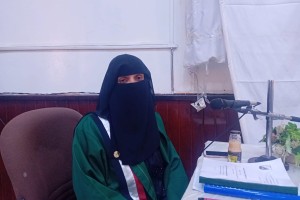
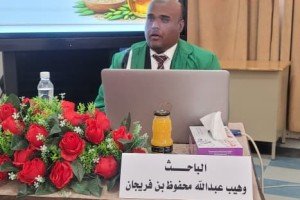
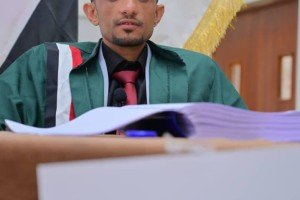
Mr. Ahmed Monnssar Murshed Mohammed Al-Dhubaibi was awarded a PhD degree in Applied Linguistics for his dissertation titled: The Use of Technology in English Language Teaching, Department of English, Faculty of Arts & Humanities, Sana’a University: Problems and Solutions, which was submitted to the Department of English Language and Literature, Faculty of Arts and Humanities – Sana’a University. The dissertation defense was held on Tuesday, February 10, 2026.

The PhD Viva-Voce Committee, which was formed based on a resolution issued by the Graduate Studies and Scientific Research Council, consisted of the following:
| # | Committee Members | Designation | Position |
| 1 | Prof. Abdelrahman Abdrabou Al-Dirbji | Internal Examiner | Chair |
| 2 | Assoc. Prof. Hamed Shoay Al-Mogarry | Main Supervisor | Member |
| 3 | Assoc. Prof. Mohammed Shoay Damoom | External Examiner | Member |
The dissertation aimed to:
- Analyze the current state of technology use in teaching English.
- Identify the gap between theoretical awareness of educational technology and its practical implementation.
- Determine the challenges hindering technology integration, such as weak infrastructure and insufficient training.
- Assess the readiness of instructors and students to use modern technologies.
- Propose practical and applicable solutions to enhance technological integration.
- Develop a scientific framework to measure the level of technology integration in higher education.
The study yielded several key findings summarized as follows:
- There is a clear gap between theoretical awareness of the importance of technology and its actual classroom implementation.
- Limited resources and inadequate administrative support significantly restrict effective technology use.
- While instructors possess general technological knowledge, they lack systematic practical training.
- The developed frameworks proved effective in measuring and guiding levels of technological integration.
- Educational improvement is possible even with limited resources if clear and practical strategies are adopted.
Scholarly Contribution: Innovative Frameworks
The researcher made an original academic contribution by developing three integrated frameworks:
- The Developed Ecological Framework (Three Levels)
A multi-level model explaining technology integration beyond traditional micro-level approaches, including:
- Individual Level: Focuses on students’ and instructors’ skills and readiness.
- Institutional Level: Encompasses resources, infrastructure, and administrative support.
- Systemic Level: Addresses educational policies and regulations.
- The Practical Implementation Framework (Five Dimensions)
A model linking theory to practice through clear implementation steps: Planning, Training, Implementation, Monitoring, and Evaluation
- The Scientific Framework for Measuring Technology Integration (Three Indicators)
A comprehensive measurement system combining:
- Quantitative indicators: Measuring the extent of technology usage.
- Qualitative indicators: Assessing the quality of integration and user experience.
- Interpretive indicators: Analyzing relationships among influencing factors.
These frameworks provide a comprehensive scientific and practical foundation for improving technology integration in higher education.
In light of these findings, the researcher recommended the following:
- Enhancing infrastructure.
- Providing systematic teacher training.
- Adopting supportive policies.
- Implementing gradual execution plans.
- Conducting future studies to expand and refine these frameworks.
The dissertation defense was attended by a number of academics, researchers, and specialists, students, colleagues, and the researcher’s family.