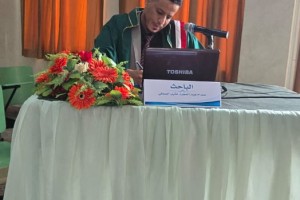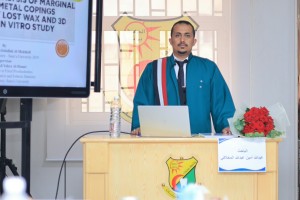
PhD Degree Awarded to Researcher Akram Abdullah Ghushaim in Agricultural Economics

Researcher Akram Abdullah Ali Ghushaim was awarded a PhD degree in Agricultural Economics for his dissertation titled: Evaluation of United Nations and International Organizations’ Projects Contributing to Poverty Reduction in Yemen: A Case Study of Food Security and Agricultural Projects, which was submitted to the Department of Agricultural Economics, Faculty of Agriculture, Food and Environment– Sana’a University. The MA defense was held on Thursday, August 20, 2026.

The PhD Viva-Voce Committee, which was formed based on a resolution issued by the Graduate Studies and Scientific Research Council, consisted of the following:
- Khaled Qasim Qaed – Sana’a University – Internal Examiner and Committee Chair.
- Ahmed Ali Al-Akwa – Thamar University – External Examiner and Committee Member.
- Prof. Khaled Nasser Al-Hajj – Sana’a University – Principal Supervisor and Committee Member.
The study aimed to:
- Evaluate food security and agricultusral projects implemented by United Nations and international organizations contributing to poverty reduction.
- Examine the implementation of international project evaluation criteria, namely relevance, efficiency, effectiveness, impact, sustainability, and promotion of innovation.
- Provide practical recommendations for policymakers to enhance the efficiency, effectiveness, and sustainability of future food security and agricultural projects.
The findings of the study showed that the United Nations and international organizations apply international evaluation criteria to food security and agricultural projects at an overall rate of 77.4%, reflecting a good level of overall implementation.
The effectiveness criterion ranked first at 82.6%, followed by efficiency at 81.4% and relevance at 81%. Impact scored 75.8%, sustainability 72.6%, and promotion of innovation 70.6%. These findings indicate variation in the level of application of the criteria, with greater emphasis on immediate operational outcomes than on long-term impact, sustainability, and innovation.
No statistically significant differences were found in project evaluations attributable to the respondents’ demographic characteristics, including gender, age, educational qualification, years of experience, and job position. Likewise, no statistically significant differences were found based on the type or age of the organization.
Statistically significant differences were found in the promotion of innovation criterion based on the number of projects implemented during the previous five years. This suggests that the accumulated experience gained from implementing a larger number of projects may contribute to enhancing organizations’ capacity to adopt and promote innovation.
In light of the aforementioned findings, the study recommended integrating sustainability into the design of food security and agricultural projects from their early stages and shifting the focus from short-term results toward achieving sustainable, long-term impact.
It also recommended activating exit strategies and transferring project ownership, knowledge, and capacities to local communities to ensure the continuity of services and benefits after external funding ends.
The study further recommended strengthening innovation as a fundamental component of project design and implementation, encouraging experimentation and knowledge sharing, and allocating the necessary resources for these activities.
It also called for greater emphasis on implementing sustainable agricultural projects and using modern technologies to improve beneficiaries’ incomes, strengthen food security, and reduce poverty.
In addition, the study recommended enhancing coordination and joint planning between United Nations and international organizations and government agencies, and linking project success assessments to sustainability and long-term impact indicators.
Finally, it recommended organizing training programs and workshops on applying international evaluation criteria and empowering local communities, as well as conducting long-term follow-up studies to assess the sustainability of project impacts after funding ends.
The defense session was attended by a number of academics, researchers, and postgraduate students, as well as the researcher’s colleagues and family members.