Master’s Degree Awarded to Mr. Moath Abdulkarim Al-Jammali in Political Science
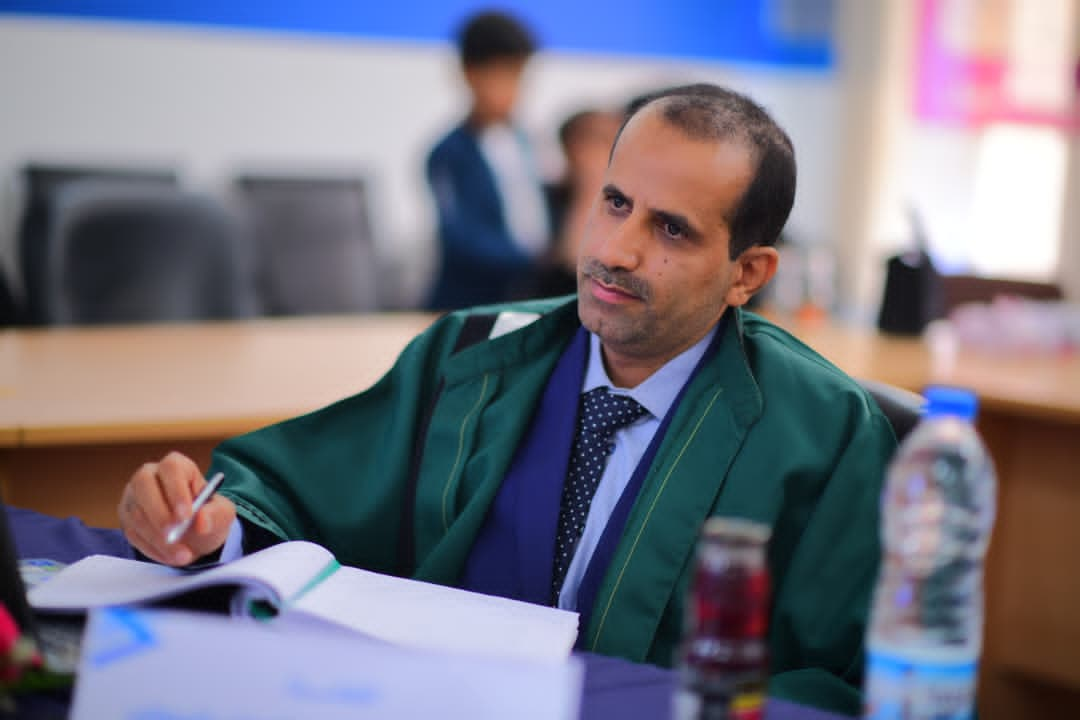
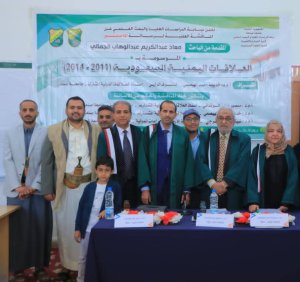
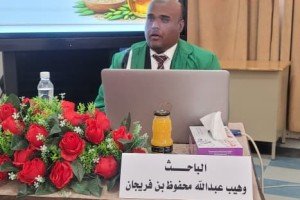
Mr. Moath Abdulkarim Abdulwahab Al-Jammali was awarded a Master’s Degree in Political Science with an average of Excellent and a grade of (92) for his thesis titled: Yemeni–Saudi Relations (2011–2014), which was submitted to the Department of Political Science – Political Science Division – Sana’a University. The MA defense was held on Tuesday, December 9, 2025.

The MA Viva-voce Committee, which was formed based on a resolution issued by the Graduate Studies and Scientific Research Council, consisted of the following:
| # | Committee Members | Designation | Position |
| 1 | Prof. Mansour Aziz Hamoud Al-Zandani | Internal Examiner | Chair |
| 2 | Prof. Khadija Ahmed Ali Al-Haisami | Main Supervisor | Member |
| 3 | Prof. Nabil Ali Ahmed Al-Sharjabi | External Examiner | Member |
The study primarily aimed to examine the impact of local, regional, and international variables on Yemeni–Saudi relations during the transitional phase following the Arab Spring (2011–2014).
The study yielded a number of key findings summarized as follows:
- Yemeni–Saudi relations prior to the Arab Spring were characterized by fluctuation between cooperation and conflict, largely shaped by the border disputes.
- Saudi Arabia maintained a dual relationship with Yemen: formally with Yemeni state institutions, and informally, politically and financially, with numerous tribal, religious, and political leaders through what is known as the “Special Committee.”
- Yemen’s potential membership in the Gulf Cooperation Council (GCC) remained dependent on the state of Yemeni–Saudi relations; periods of improved relations strengthened this possibility, while periods of tension significantly weakened it, given that Saudi Arabia is the primary gateway for any Yemeni integration into the Gulf system.
- During the 2011 Arab Spring, Saudi Arabia sought to contain the Yemeni youth revolution through the Gulf Initiative out of concern about the spread of regional unrest.
- Domestic transformations in both Yemen and Saudi Arabia during the study period (2011–2014) contributed to a decline in bilateral relations.
- Regional shifts following the Arab Spring further strained relations, as Saudi Arabia adjusted its priorities in Yemen and reduced its presence there.
- The deepening international influence in Yemen after the Arab Spring drove a significant wedge in Yemeni–Saudi relations, reflected in clear indicators of decline across political, security, and economic levels.
In light of these findings, the researcher recommended the following:
- Enhancing cooperation and complementarity between Yemen and Saudi Arabia on political, economic, and security fronts, given the long-standing geographical proximity and shared interests.
- Ensuring that bilateral relations are governed by diplomatic norms, mutual respect, and state-to-state engagement, rather than informal networks that have ultimately proven ineffective.
- Encouraging Saudi Arabia to support Yemen’s accession to the GCC, as this would strengthen Yemen’s political presence and demographic weight and benefit both sides.
- Shifting the relationship toward development and economic cooperation—such as establishing joint markets and free-trade zones on both sides of the border—instead of relying on previous security-centric approaches like border fences and buffer zones.
- Developing Saudi analytical tools to achieve a deeper understanding of Yemen’s political and social structures, and avoiding unfair treatment of Yemeni expatriates affected by recent regulatory changes.
- Encouraging Saudi Arabia to play an active role in financing Yemen’s reconstruction programs, in coordination with regional and international partners, and in supporting Yemen’s economy.
- Promoting Saudi cooperation with regional and international stakeholders to help facilitate a comprehensive political settlement to the Yemeni crisis that safeguards the interests of all parties.
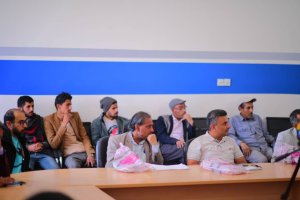
The defense session was attended by faculty members, researchers, students, colleagues, and the researcher’s family.