Master’s Degree Awarded to Ms. Naseem Amer in Translation

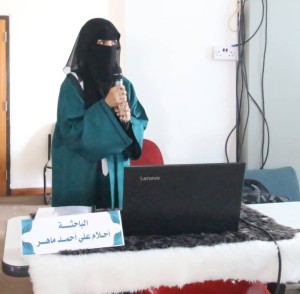
Ms. Naseem Abdullah Abdullah Mohammed Amer was awarded a Master’s Degree in Translation with an average of Excellent and a grade of (95%) for her thesis titled: Motivation Choices of Professional Translation in Translating Magazine Articles from English to Arabic: Forced Migration Review Magazine as a Case-in-Point, which was submitted to the Community Center for Translation and Language Teaching – Sana’a University. The MA defense was held on Monday, May 18, 2026.
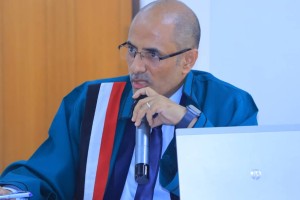
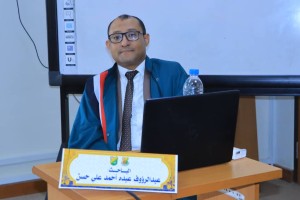
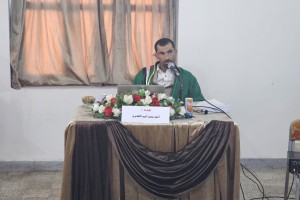
The MA Viva-voce Committee, which was formed based on a resolution issued by the Graduate Studies and Scientific Research Council, consisted of the following:
| # | Committee Members | Designation | Position |
| 1 | Prof. Ibraheem N. Tagaddeen | Internal Examiner | Chair |
| 2 | Assoc. Prof. Mujeeb Ali Qasim | Main Supervisor | Member |
| 3 | Prof. Mansour Jarallah Ahmed Sarhan | External Examiner | Member |
The thesis aimed to:
- Explore translation challenges and problems in articles translated from English into Arabic in the journal Forced Migration Review (FMR).
- Identify the strategies applied to address these challenges based on Baker’s (2018) classification of non-equivalence at the word level.
- Evaluate the motivations underlying translators’ choices according to Maslow’s hierarchy of needs.
- Analyze the reasons behind the selection of translation strategies and relate each level of Maslow’s hierarchy to different translation strategies.
The study yielded several key findings summarized as follows:
- Translators’ choices of translation strategies are not random, but are motivated by Maslow’s hierarchy of needs, including safety, belongingness, self-esteem, and self-actualization.
- Translators employ specific strategies to satisfy different needs within Maslow’s hierarchy.
- There exists a continuous motivational progression in translators’ behavior, moving from safety needs toward self-actualization.
- Translation is not merely a linguistic process, but also a psychological process driven by motivation.
In light of these findings, the researcher recommended the following:
- Exploring non-equivalence beyond the word level, including lexical patterns such as collocations, idiomatic expressions, and fixed phrases.
- Investigating grammatical non-equivalence problems related to number, gender, and person.
- Giving greater attention to textual equivalence, including thematic and informational structures.
- Encouraging future studies on pragmatic equivalence, as achieving coherence, cohesion, and meaning reconstruction represents a major challenge in translation.
The defense session was attended by a number of academics, researchers, students, colleagues, and the researcher’s family.