PhD Degree Awarded to Ms. Rema Kamel Al Sharabi in Arabic Linguistics
- Posted by كلية اللغات جامعة الصنع
- Categories news
- Date July 4, 2025

Ms. Rema Kamel Farhan Hasan Al Sharabi was awarded a PhD degreeinArabic Linguistics for herdissertation titled:The Quranic Verse-Endings (Al-Fasila Al-Quraniya) in Surat Al-Anbiya and Surat Al-Ḥajj:A Semantic and Linguistic Study,which was submitted tothe Department of Arabic Language, Faculty of Languages, Sana’a University. The dissertation defense was held on Tuesday, June 24, 2025.
The PhD Viva-Voce Committee, which was formed based on a resolution issued by the Graduate Studies and Scientific Research Council, consisted of the following:
# | Committee Members | Designation | University | Position |
1 | Prof. Fatoum Ali Hassan Al-Ahdal | ExternalExaminer | HodeidahUniversity | Chair |
2 | Assoc. Prof. Adnan Yousef Al-Shuaibi | Representative of Main Supervisor | Sana’a University | Member |
3 | Assoc. Prof. Ahmed Hassan Al-Arousi | Internal Examiner | Sana’aUniversity | Member |
The research aimed to:
- Explore the significance of verse-ending science within the Quranic context.
- Highlight the phonetic features of Quranic verse-endings.
- Explain the syntactic positions of Quranic verse-endings.
- Clarify the semantic implications embedded within Quranic verse-endings.
- Consolidate prior scholarly efforts in this field.
- Examine the verbal and semantic coherence between the Quranic verse-endingsand the initial clause of the verse to which they are affixed.
The research has yielded a number of key findings, as follows:
- A consummate and precise harmony is evident between the verses of Al-Anbiya and Al-Ḥajj and their respective verse-endings, which manifests an unparalleled degree of precision and mastery. While some verse-endings exhibit clear and immediate connections, others demand profound contemplation to unveil the nuanced connections between the verse-endings and the verse’s core meaning.
- The Quranic verse ending is imbued with intentional and profound semantic significance; it is not merely a device for rhyme or ornamentation, as some have suggested.
- The verse-ending is distinguished by its capacity to captivate the listener through an unlabored, exquisite phonetic pattern, harmonizing with its counterparts to form beautiful, resonant sound segments, which is rich with cohesive and inimitable meaning.
- Both Al-Anbiya and Al-Ḥajj converge in their discourse on the Day of Resurrection, its attendant terrors, the states of humanity therein, and resurrection, alongside narrations of prophets and their respective peoples. However, each Surat retains a distinct thematic focus: Surat Al-Anbiya centers on the Oneness of Divinity (Tawḥid Al-uluhiyyah), while Surat Al-Ḥajj highlights the sanctity and exaltation of religious rites.
- A particularly noteworthy finding of the Study is that deviation from expected syntactic or morphological patterns in the verse-endings often serves to enhance their phonological harmony with adjacent verses. However, such deviations have a more profound and compelling objective: the inherent inimitability of verse-endings in their divinely ordained form, an inimitability not discernible were they to conform to their conventional linguistic structure.
- The verse-endings in Surat Al-Anbiya exhibit a convergence in phonemes that are either identical or proximate in their points and manners of articulation. This indicates that the phonetic resonance of Al-Anbiya verse-endings aligns with their unified function in signifying the Surat’s theme and the specific context of the verse.
- Devices of syntactic arrangement, such as foregrounding and postponement, play a prominent role within these verse-endings. They have various functions such as emphasis, exclusivity, and thematic focus.
- The interrogative style contributes significantly to the prominence of verse-endings. Its functions range from denunciation and reprimand to expressions of wonder.
- The phenomena of explicit mention and ellipsis are manifest in these verse-endings, which underscores the concision and inimitability of the Quranic discourse.
- The verse-endings incorporate the stylistic feature of expressing hope, with its manifestations varying between expressing aspirations for success, gratitude, and guidance.
- Emphasis holds a conspicuous role within the Quranic verse-endings particularly in Surat Al-Ḥajj, where it frequently appears in conjunction with the Beautiful Names of Allah
- The verse-endings employ stylistic feature of negation, which clearly indicates another layer of the inimitability of the Quran.
- The verse-endings encompass verbs of praise and censure. However, verbal expressions of praise and censure are only evident in Surat Al-Ḥajj.
- The verse-endings incorporating the Beautiful Names of Allah are particularly prominent in Surat Al-Ḥajj. As previously noted, such verse-endings are frequently coupled with emphasis.
The researcher concluded the defense with several significant recommendations, including:
- Devoting greater scholarly attention to studies pertaining to the Holy Quran, whose wonders never cease, to further unveil its eloquence.
- Encouragingresearchers to further exploreQuranic verse-endings to uncover their linguistic and phonetic inimitability.
- Re-presenting the contributions of earlier scholars on Quranic verse-endingswith the aim to produce renewed investigations and to enrich such contributions through contemplation and reflection.
The dissertation defense was attended by a number of academics, researchers, students, interested participants as well as the researcher’s colleaguesand family members.
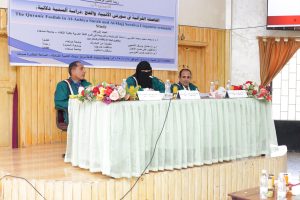
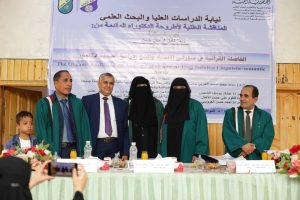


A recorded part of the Viv-Voce session

Previous post
Faculty of Languages Inaugurates New Academic Year with a Week of Excellence and Academic Engagement
You may also like

Master’s Thesis Proposal Seminar for Mr. Jehad Mohsen Ahmed Salman