PhD Degree Awarded to Mr. Mohammed Shaybah Qasem Al-Ahdal in Islamic Jurisprudence and Its Foundations
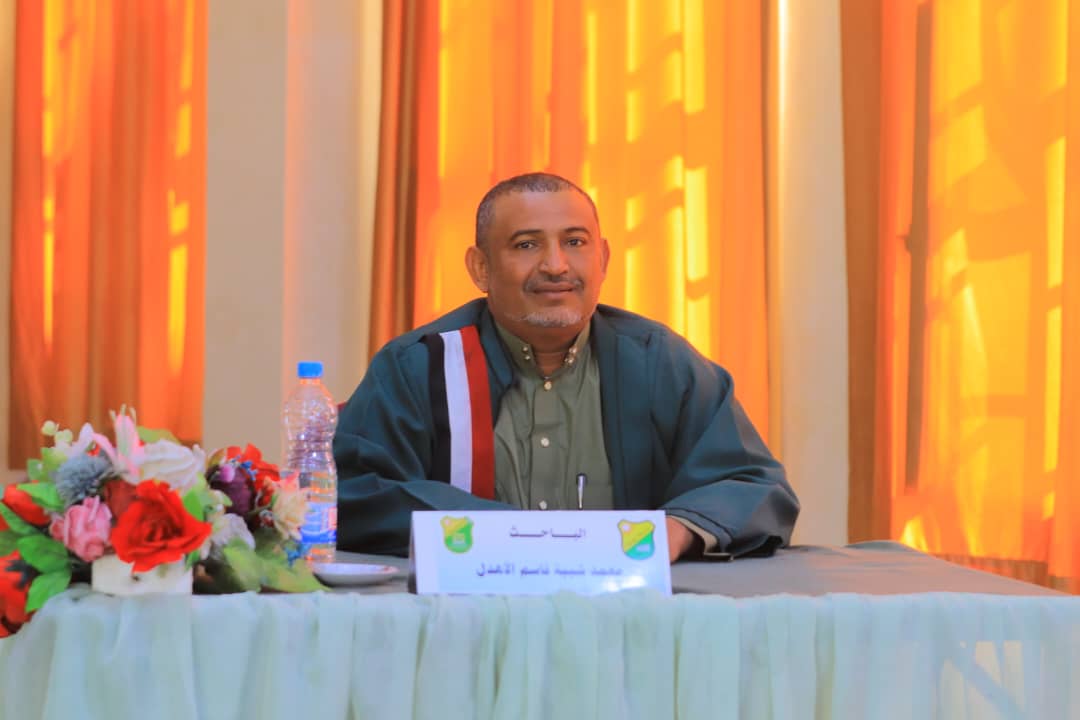
Mr. Mohammed Shaybah Qasem Al-Ahdal was awarded a PhD degree in Islamic Jurisprudence and Its Foundations for his dissertation titled: Fatawa of Sulaiman bin Yahya bin Omar Maqbool Al-Ahdal (d. 1197 AH): From the Beginning of Purification Chapter to the End of the Manuscript, which was submitted to the Department of Islamic Studies, Faculty of Arts and Humanities – Sana’a University. The dissertation defense was held on Wednesday, December 3, 2025.
The PhD Viva-Voce Committee, which was formed based on a resolution issued by the Graduate Studies and Scientific Research Council, consisted of the following:
# |
Committee Members |
Designation |
Position |
1 |
Prof. Kawthar Hamoud Al-Mekhlafi |
Internal Examiner |
Chair |
2 |
Prof. Adel Saleh Al-Faqih |
Main Supervisor |
Member |
3 |
Assoc. Prof. Mustafa Mahmoud Al-Rousi |
External Examiner |
Member |
The study aimed to:
-
Introduce the author, Sulaiman bin Yahya bin Omar Maqbul Al-Ahdal, his scholarly and personal life, and methodology and sources of his Fatawa.
-
Present and describe the manuscript of his collected Fatawa.
-
Edit and produce the manuscript in a sound scholarly manner, ensuring accurate verification and annotation.
The study yielded a number of key findings summarized as follows:
-
Sulaiman Al-Ahdal was among Yemen’s eminent His family in Zabid is renowned for its scholarly tradition in jurisprudence, issuing Fatawa, and serving the sciences of hadith and elevated chains of transmission (Asanid Alhadith). His wide-ranging knowledge, particularly in hadith and Islamic jurisprudence, is evident throughout his Fatawa.
-
Al-Ahdal employed a clear methodological approach and terminology consistent with the jurisprudential conventions of Shafi‘i scholars, demonstrating his expertise, depth, and commitment to the science of jurisprudence
-
His Fatawa are arranged according to the classical Shafi‘i jurisprudence structure within the section on acts of worship, beginning with purification and ending with They do not cover all traditional jurisprudential issues; rather, they address questions posed to the author during his time, with each issue placed in its appropriate chapter.
-
The author addressed and refuted several erroneous concepts and false beliefs held by some individuals of his era, defending sound creed and clarifying the invalidity of such misconceptions and the ignorance of their proponents through Sharia textual evidence.
-
The Fatawa compile the opinions of both early and later Shafi‘i jurists across most jurisprudential In some instances, the author cites sources through intermediaries such as Ibn Hajar Al-Haytami and others.
In light of these findings, the researcher recommended:
-
Conducting further studies on the jurisprudential and foundational heritage of Tihama scholars and encouraging researchers to explore and uncover the valuable Tihami manuscripts that still lie dormant on the shelves of public and private libraries
-
Establishing a manuscript center in Tihama, Yemen, dedicated to Tihami studies and manuscripts, and linking it with universities, given the region’s rich collection of rare manuscripts that are currently at risk of
-
Developing academic studies focused on documenting the scholarly contributions of prominent Yemeni families and compiling their intellectual heritage into independent reference works.
-
Encouraging researchers, research centers, and Yemeni universities to collect and critically edit Yemeni Fatawa manuscripts across Zaydi, Shafi‘i, and Hanafi schools, and to compile them into a comprehensive encyclopedic reference for global scholarly use.
The dissertation defense was attended by a number of academics, researchers, and specialists, students, colleagues, and the researcher’s family.

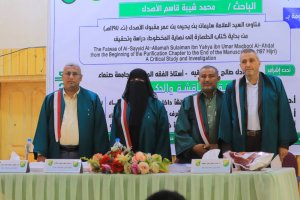

A video from the Viva-Voce