PhD Degree Awarded to Ms. Nawal Abdulmughni in Islamic Creed and Thought

Ms. Nawal Mohammed Ahmed Abdulmughni was awarded a PhD degree in Islamic Creed and Thought for her dissertation titled: Umdat Al-Mustarshideen fi Usul Al-Deen,’ a Commentary on Al-Aqidah Al-Mansuriyyah by the Scholar Hamid bin Ahmed Al-Mahalli (d. 652 AH): A Critical Study and Investigation of Part One from Folio No. 1 to Folio No. 102 , which was submitted to the Department of Islamic Studies, Faculty of Arts and Humanities–Sana’a University. The dissertation defense was held on Saturday, May 19, 2026 .
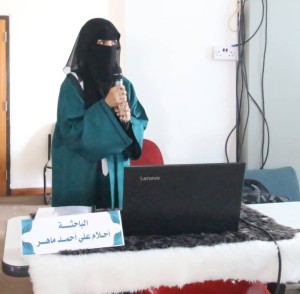
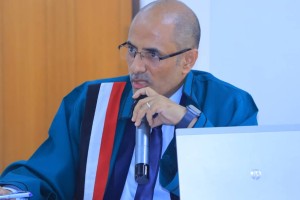
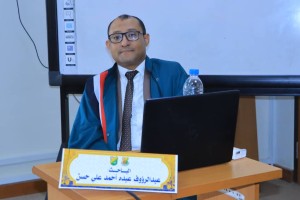
The PhD Viva-Voce Committee, which was formed based on a resolution issued by the Graduate Studies and Scientific Research Council, consisted of the following:
| # | Committee Members | Designation | Position |
| 1 | Prof. Kawthar Hamoud Al-Mekhlafi | Internal Examiner | Chair |
| 2 | Prof. Huda Ali Yahya Al-Emad | Main Supervisor | Member |
| 3 | Prof. Abdullah Mohammed Ali Al-Fallahi | External Examiner | Member |
The dissertation aimed to:
- Introduce the scholar Hamid bin Ahmed Al-Mahalli (d. 652 AH) as an influential scholarly figure through his work “‘Umdat Al-Mustarshideen fi Usul Al-Deen.”
- Present Al-Mahalli’s methodology in Islamic creed, Qur’anic studies, language, and rhetoric.
- Compile the author’s opinions and scholarly preferences in theology, creed, and language.
- Highlight the significance and distinctive features of the manuscript “‘Umdat Al-Mustarshideen fi Usul Al-Deen.”
- Clarify the author’s methodology in the book.
- Identify the sources upon which Hamid Al-Mahalli relied.
- Produce a sound scholarly edition of the manuscript through proper verification, annotation, documentation, and study.
- Contribute to the preservation and publication of Islamic heritage, particularly Yemeni heritage.
- Enrich the Islamic library with this work and make it accessible to students and researchers for further benefit and study.
The study yielded several key findings summarized as follows:
- Hamid Al-Mahalli was among the leading scholars of Usul al-Deen due to his extensive knowledge of earlier theological works and writings. The researcher found that he frequently cited numerous sources, some of which still exist only in manuscript form, while preserving many scholarly opinions in his work, particularly through his responses to opposing sects.
- The Zaydi School distinguished itself from other Islamic schools through its rejection of fanaticism and intellectual rigidity, emphasizing knowledge, practice, ijtihad, research, and creativity.
- Zaydi scholars relied on the Qur’an, the Prophetic Sunnah, the Arabic language, and the heritage and transmitted narrations of Ahl al-Bayt in their study and discussion of issues related to the foundations of religion.
The dissertation defense was attended by a number of academics, researchers, and specialists, students, colleagues, and the researcher’s family.