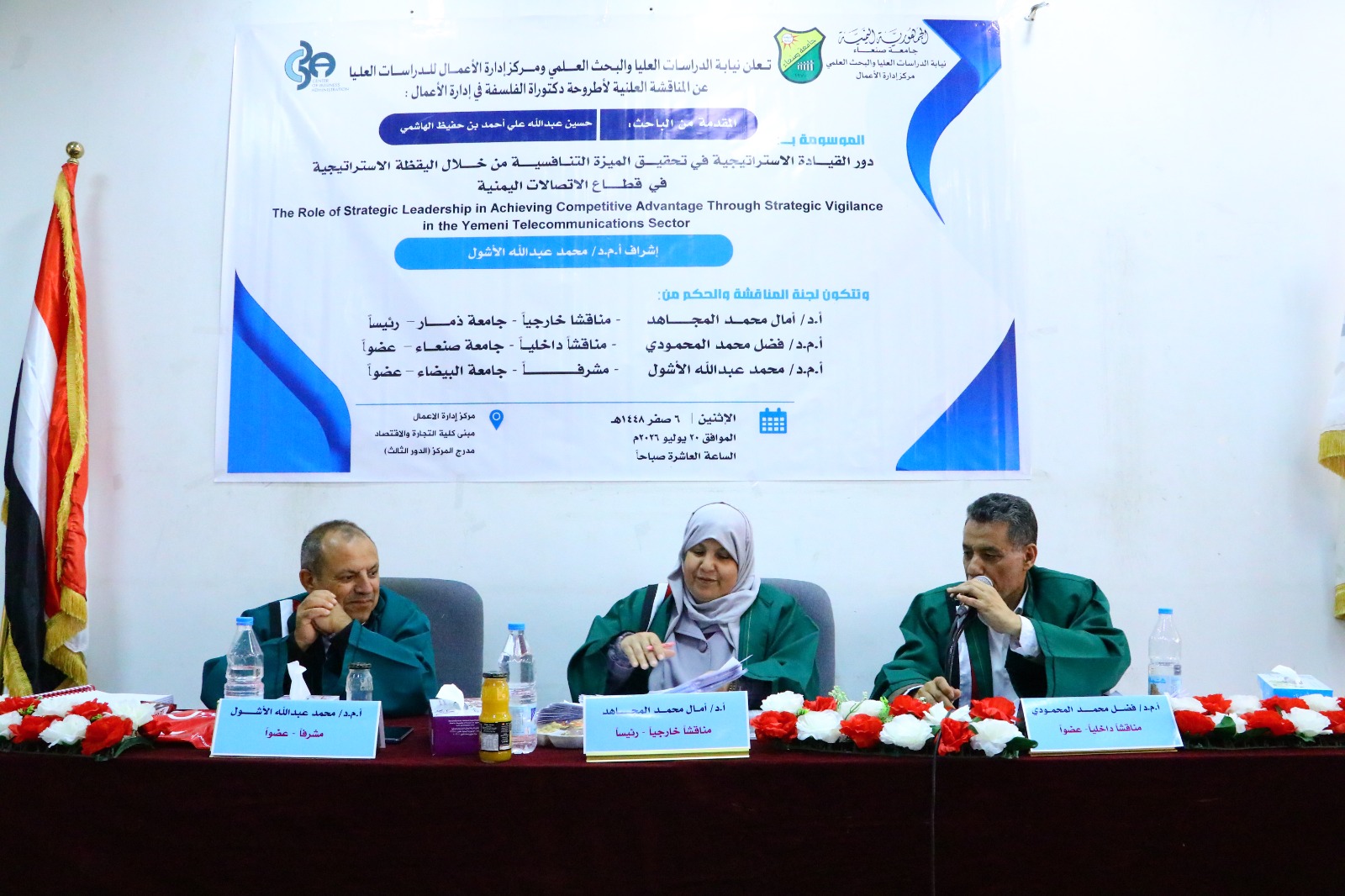
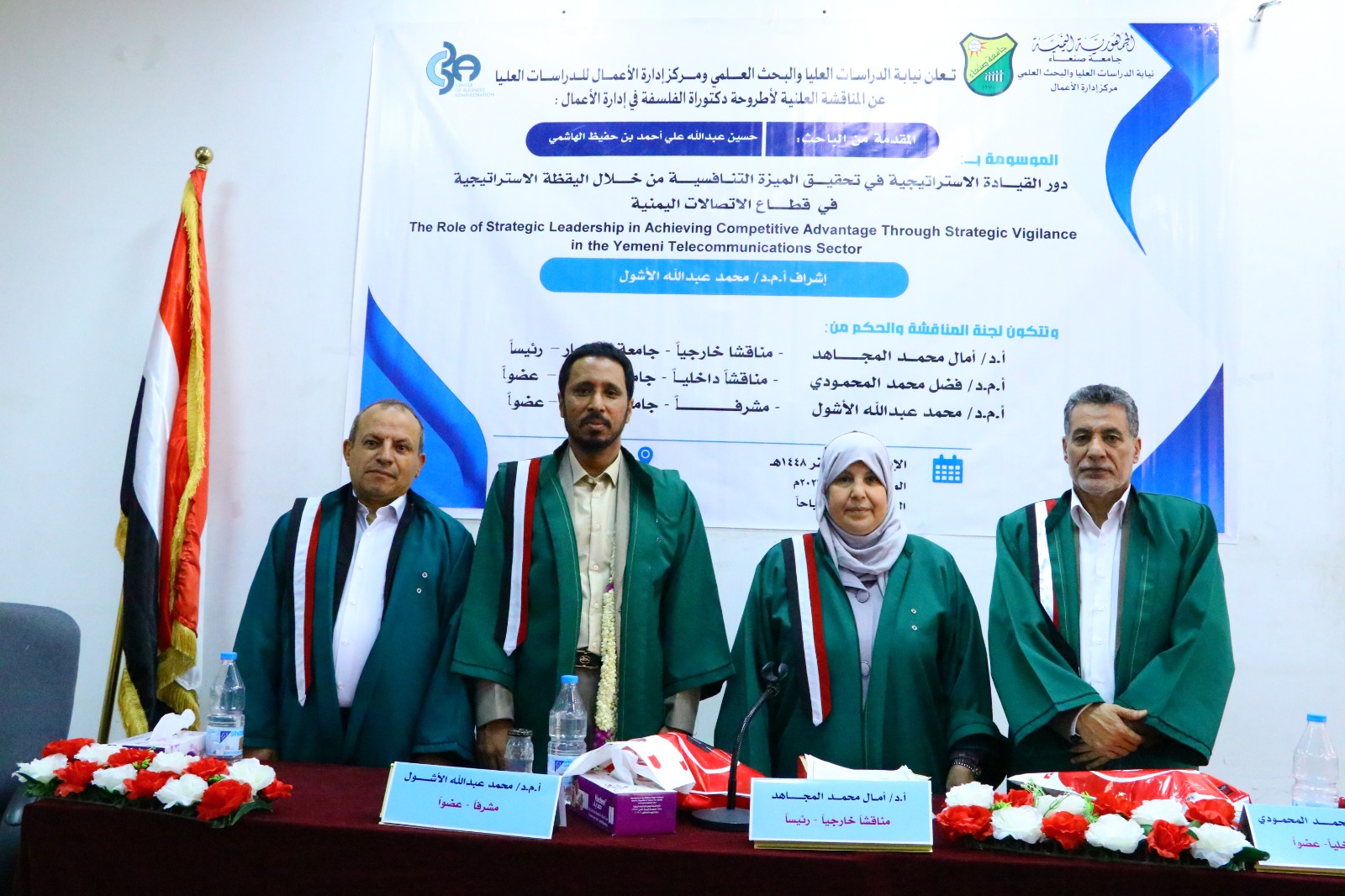
Sana’a University – Monday, July 20, 2026
Mr. Hussein Abdullah Ali Ahmed Bin Hafiz Al-Hashemi has successfully obtained his PhD degree in the Philosophy of Business Administration from the Center of Business Administration Studies, Sana’a University. His dissertation, titled: “The Role of Strategic Leadership in Achieving Competitive Advantage Through Strategic Vigilance in the Yemeni Telecommunications Sector“, was supervised by Associate Professor Dr. Mohammed Abdullah Al-Ashwal.
The Viva-Voce Committee, formed based on a resolution issued by the Post-Graduate Studies and Scientific Research Council, consisted of the following members:
- Prof. Amal Mohammed Al-Mujahid – External Examiner and Chair, Dhamar University.
- Assoc. Prof. Fadhl Mohammed Al-Mahmoudi – Internal Examiner, Sana’a University.
- Assoc. Prof. Mohammed Abdullah Al-Ashwal – Supervisor, Al-Bayda University.
The Viva-Voce was attended by a number of academics, researchers, students, and interested participants, as well as several colleagues and family members of the researcher.
This study aimed to investigate the role of strategic leadership in achieving competitive advantage through strategic vigilance in the Yemeni telecommunications sector. It also sought to assess the level of strategic leadership practices, strategic vigilance, and competitive advantage within the sector under study. The study adopted a quantitative approach using both descriptive and analytical methods and employed a questionnaire as the primary instrument for data collection.
The study population comprised all employees occupying leadership and supervisory positions in the Yemeni telecommunications sector, totaling 790 employees across five telecommunications organizations located in Sana’a, Yemen: the Public Telecommunications Corporation (PTC), Yemen Mobile, Sabafon, YOU, and TeleYemen. A stratified random sample of 316 respondents was selected, of which 286 valid questionnaires were returned and deemed suitable for analysis, yielding a response rate of 93.67%.
Covariance-Based Structural Equation Modeling (CB-SEM) was employed to analyze the proposed relationships among the study variables. Statistical analyses were conducted using the Statistical Package for the Social Sciences (SPSS) version 27 and AMOS version 25 to achieve the study objectives and test its hypotheses.
The findings revealed that strategic vigilance plays a statistically significant partial mediating role in the relationship between strategic leadership and competitive advantage. The results also indicated statistically significant positive direct effects among the study variables, whereby strategic leadership positively influences both strategic vigilance and competitive advantage, while strategic vigilance positively contributes to the achievement of competitive advantage. At the dimensional level, commercial vigilance was found to play a statistically significant partial mediating role in the relationship between strategic leadership and competitive advantage. In contrast, neither technological vigilance nor environmental vigilance demonstrated a statistically significant mediating effect.
The study concluded that achieving competitive advantage in the Yemeni telecommunications sector requires an integration of strategic leadership practices and strategic vigilance mechanisms. Moreover, commercial vigilance represents the most influential dimension of strategic vigilance in strengthening this relationship, enabling telecommunications companies to better sense and respond to market changes, thereby enhancing their ability to achieve and sustain competitive advantage