
PhD Degree Awarded to Researcher Majed Mohammed Al-Kumaim in Business Administration
- Posted by مركز إدارة الأعمال جامعة صنعاء
- Categories News & Events
- Date August 11, 2026

Researcher Majed Mohammed Saleh Al-Kumaim was awarded a PhD degree in Business Administration for his dissertation titled: The Role of Strategic Agility in Achieving Competitive Advantage through Entrepreneurial Orientation in Yemeni Banks: A Field Study, which was submitted to the Center of Business Administration –Sana’a University. The dissertation defense was held on Tuesday, August 11, 2026.
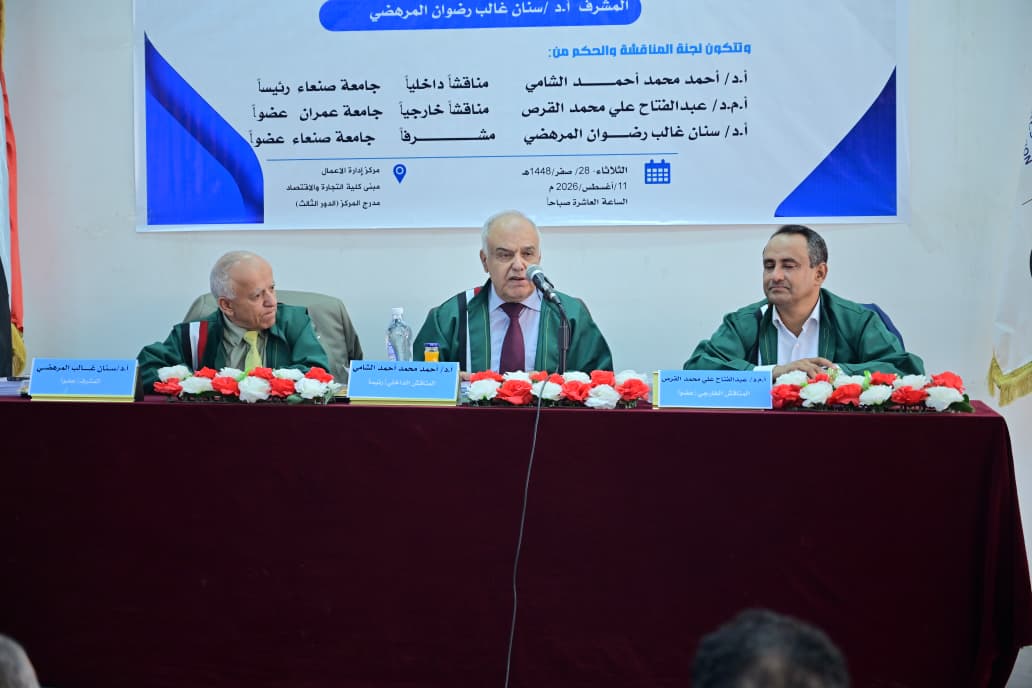
The PhD Viva-Voce Committee, which was formed based on a resolution issued by the Graduate Studies and Scientific Research Council, consisted of the following:
# | Committee Members | Designation | Position |
1 | Prof. Ahmed Mohammed Al-Shami | Internal Examiner | Chair |
2 | Prof. Sinan Ghaleb Al-Marhadi | Main Supervisor | Member |
3 | Assoc. Prof. Abdul Fattah Ali Al-Qurs | External Examiner | Member |
The study aimed to examine the role of strategic agility and its dimensions—vision and goal clarity, strategic sensitivity, core capabilities, shared responsibility, and appropriate decision-making—in achieving competitive advantage through entrepreneurial orientation in Yemeni banks.
It also sought to determine the extent to which the mediating variable of entrepreneurial orientation—with its dimensions of creativity and innovation orientation, proactiveness, competitive aggressiveness, autonomy, and risk-taking—mediates the relationship between strategic agility and competitive advantage in Yemeni banks.
The study adopted a descriptive-analytical approach. The study population comprised 700 senior, middle, and executive management leaders working in 16 Yemeni banks in the Capital Secretariat, Sana’a. The sample consisted of 350 participants, representing 50% of the population, in accordance with the statistical requirements for Structural Equation Modeling (SEM), which require a minimum of five observations for each of the 70 questionnaire items.
The researcher developed a questionnaire as the primary data collection instrument and used SmartPLS for statistical analysis and Structural Equation Modeling. The questionnaire was distributed in accordance with each bank’s policies through its human resources departments to a purposive, non-probability sample.
The findings showed that the direct effect of strategic agility on competitive advantage in Yemeni banks was 0.211. In the presence of the mediating variable of entrepreneurial orientation, the effect increased by approximately three and a half times, reaching a total effect coefficient of 73.1%, and this effect was statistically significant. The findings also showed that entrepreneurial orientation partially mediated the relationship between strategic agility and competitive advantage.
Regarding the sub-dimensions of strategic agility, the findings showed statistically significant effects. The effect of vision and goal clarity on competitive advantage was 0.164, increasing by approximately four times in the presence of entrepreneurial orientation, with a total effect coefficient of 64.9%. Entrepreneurial orientation partially mediated the relationship between vision and goal clarity and competitive advantage.
The effect of strategic sensitivity on competitive advantage was 0.151, increasing by more than four times in the presence of entrepreneurial orientation, reaching an effect coefficient of 62%. The mediation between strategic sensitivity and competitive advantage was partial.
The effect of core capabilities on competitive advantage was 0.153, increasing by approximately four and a quarter times in the presence of entrepreneurial orientation, reaching an effect coefficient of 64.6%. Entrepreneurial orientation partially mediated the relationship between core capabilities and competitive advantage.
The findings also demonstrated a statistically significant effect of shared responsibility on competitive advantage, with full mediation by entrepreneurial orientation in Yemeni banks and a total effect coefficient of 57.7%. Likewise, appropriate decision-making had a statistically significant effect on competitive advantage, with full mediation by entrepreneurial orientation and a total effect coefficient of 62.7%.
The study recommended that Yemeni banks organize training courses in strategic management, with particular emphasis on strategic agility as a contemporary management philosophy, as well as training employees at various management levels in entrepreneurship and entrepreneurial orientation. Such training would familiarize employees with their concepts, dimensions, components, and characteristics and develop their related skills, given their importance as sources of competitive advantage.
The study further recommended clarifying the complementary relationship between strategic agility and entrepreneurial orientation and their joint role in achieving competitive advantage, while training employees in sound practices related to entrepreneurial orientation and strategic agility.
It also emphasized the importance of Yemeni banks, amid continuous and accelerating environmental changes, focusing on responding rapidly to and adapting to such changes from an entrepreneurial perspective. This should include pursuing competitive advantage by improving the quality and delivery of banking services, leveraging technological developments and communication technologies to meet customers’ needs and preferences in ways compatible with their purchasing power, and providing diverse services that address the needs of different customer segments.
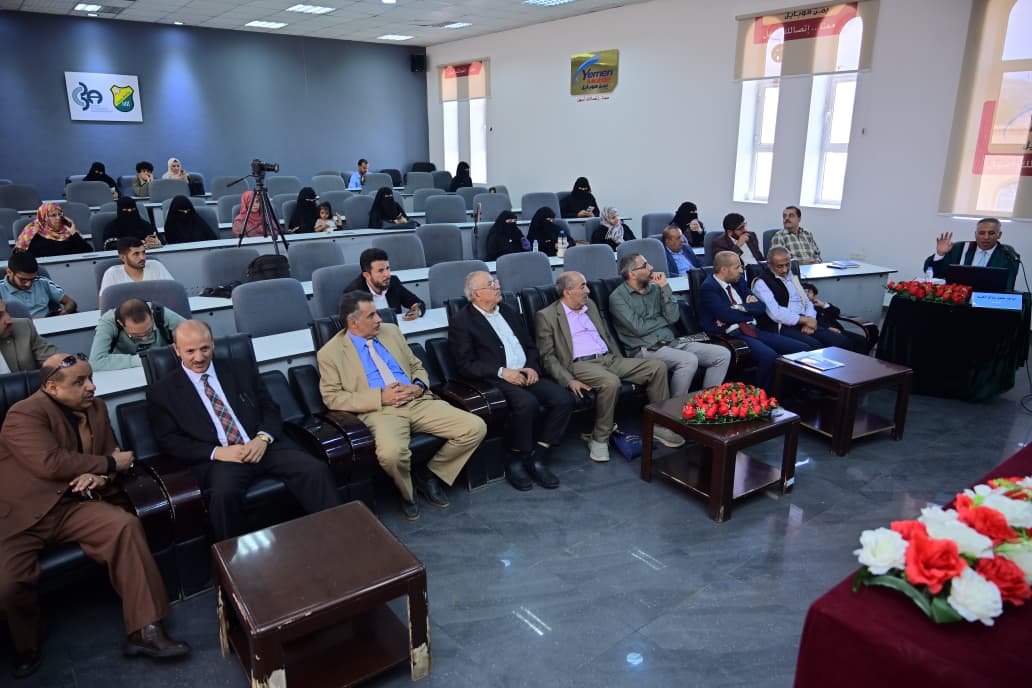
The dissertation defense was attended by a number of academics, postgraduate students, researchers, as well as the researcher’s colleagues and family members.


Previous post
PhD Degree Awarded to Researcher Ibrahim Mohammed Al-Faqih in Business Administration
Next post