Master’s Degree Awarded to Researcher Rina Al-Maamari for Study on CAD/CAM-Fabricated Temporary Crowns
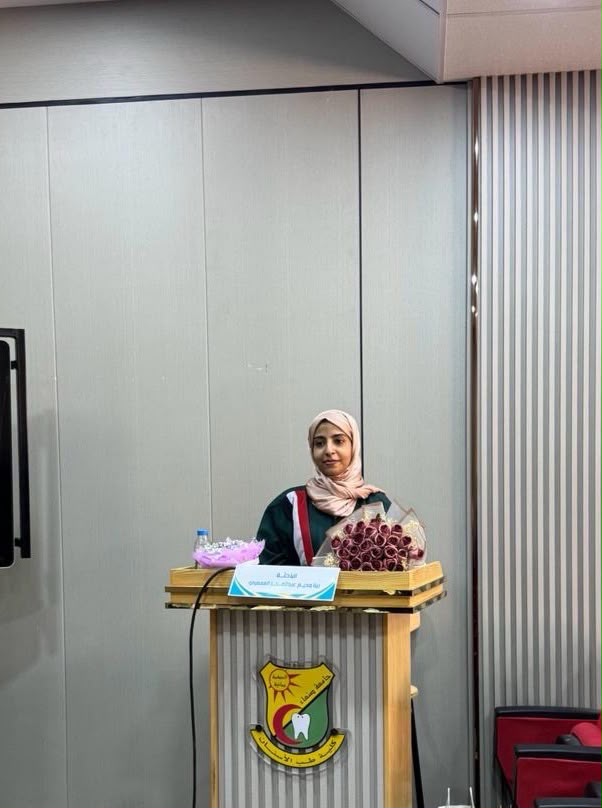
Researcher Rina Wadea Abdulaziz Al-Maamari was awarded a Master’s Degree in Conservative Dentistry for her thesis titled: Evaluation of Microleakage in PMMA Temporary Crowns Fabricated Using CAD/CAM Technology and the Conventional Technique, which was submitted to the Department of Conservative Dentistry, Faculty of Dentistry– Sana’a University. The MA defense was held on Tuesday, June 30, 2026.
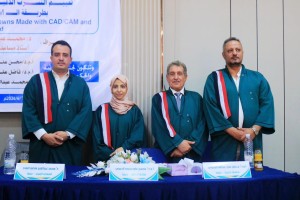
The MA Viva-voce Committee, which was formed based on a resolution issued by the Graduate Studies and Scientific Research Council, consisted of the following:
| # | Committee Members | Designation | Position |
| 1 | Assoc. Prof. Mohsen Ali Yahya Al-Hamzi | Internal Examiner | Chair |
| 2 | Dr. Mohammed Abdulaziz Mansour Al-Baili | Main Supervisor | Member |
| 3 | Assoc. Prof. Fadhel Ali Abdullah Al-Sanbani | External Examiner | Member |
The study generally aimed to evaluate and compare the marginal microleakage of long-term provisional crowns fabricated from polymethyl methacrylate (PMMA) using the conventional technique and Computer-Aided Design/Computer-Aided Manufacturing (CAD/CAM) technology.
The study sets to achieve the following specific objectives:
- To compare the degree of marginal microleakage between CAD/CAM-fabricated crowns and conventionally fabricated crowns.
- To assess the effect of surface location (buccal and lingual) on microleakage within each group.
- To perform a statistical comparison of microleakage scores across the different crown surfaces.
The findings demonstrated the superior performance of the CAD/CAM group, which exhibited significantly lower microleakage scores than the conventional group (p = 0.050). The buccal surfaces also showed lower microleakage than the lingual surfaces in both groups.
Regarding the occlusal surface, no microleakage was observed in the CAD/CAM group, whereas the conventional group exhibited more severe microleakage extending to the occlusal surface. The study further identified statistically significant differences in favor of the CAD/CAM group on the buccal surfaces, while the differences observed on the lingual surfaces were not statistically significant.
The study recommended conducting further research using larger sample sizes and different margin designs, undertaking long-term clinical studies, simulating oral conditions through thermal and mechanical aging, comparing additional fabrication techniques such as three-dimensional (3D) printing, evaluating different temporary luting cements and their effect on microleakage, and assessing the cost-effectiveness of CAD/CAM technology compared with conventional fabrication methods.
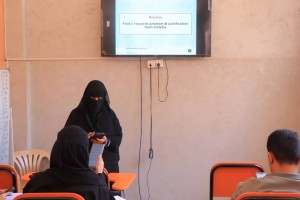
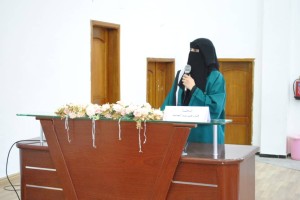
The thesis defense was attended by faculty members, researchers, and students of the Faculty of Dentistry, as well as the researcher’s colleagues and family members.