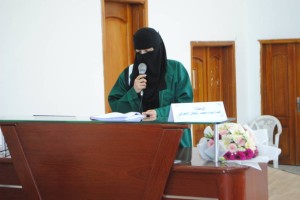
Master’s Degree Awarded to Ms. Wafaa Mohammed Al-Sherrai in Orthodontics
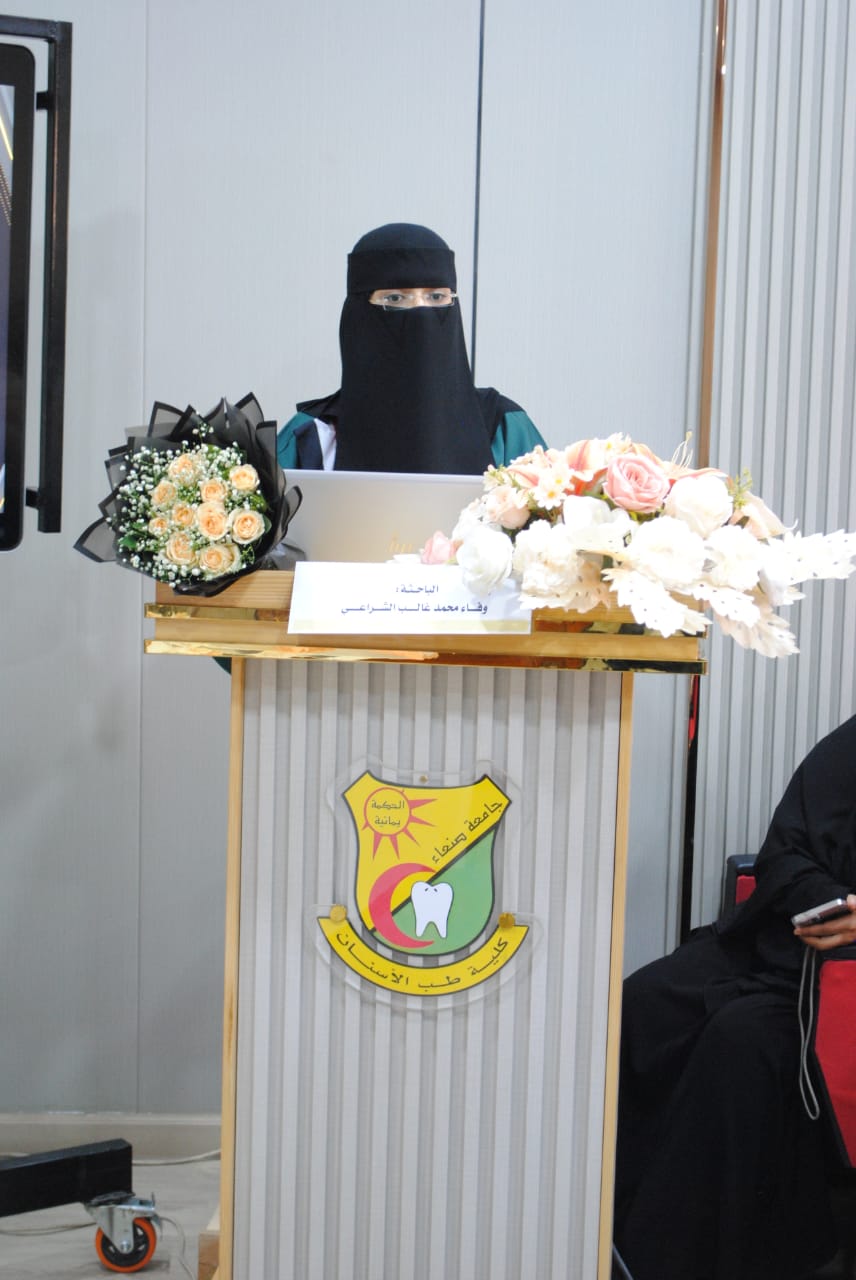
Ms. Wafaa Mohammed Ghaleb Al-Sherrai was awarded a Master’s Degree in Orthodontics for her thesis titled: Skeletal and Dentoalveolar Dimensions in Cases of Unilateral Palatally Impacted Canines: A Cone-Beam Computed Tomography Study, which was submitted to the Department of Orthodontics, Faculty of Dentistry – Sana’a University. The MA defense was held on Tuesday, January 20, 2026.
The MA Viva-voce Committee, which was formed based on a resolution issued by the Graduate Studies and Scientific Research Council, consisted of the following:
| # | Committee Members | Designation | Position |
| 1 | Prof. Ghamdan Abdullah Al-Harazi | Internal Examiner | Chair |
| 2 | Prof. Naelah Mohammed Al-Mujahid | Main Supervisor | Member |
| 3 | Prof. Khaled Ahmed Al-Dara’i | External Examiner | Member |
The study aimed to conduct a three-dimensional comparison of skeletal and dentoalveolar dimensions in patients with unilateral palatal canine impaction, compare the impacted and non-impacted sides, and assess differences according to gender, presence or absence of the deciduous canine, and side of impaction.
The study yielded a number of key findings summarized as follows:
- Unilateral palatal impaction of the maxillary canine was associated with significant asymmetry in skeletal and dentoalveolar dimensions.
- The impacted side showed smaller alveolar width at the premolar region, smaller canine dimensions, and shorter quadrant length.
- Significant differences were observed in the lateral inclination of incisors and canines between the impacted and non-impacted sides.
- Retention of the deciduous canine was associated with increased alveolar and dental width at the premolar region.
In light of these findings, the researcher recommended the following:
- Using cone-beam computed tomography (CBCT) for early diagnosis of unilateral palatal impaction of the maxillary canine.
- Assessing alveolar width at the premolar level and early intervention with appropriate expansion.
- Careful treatment planning to avoid root resorption and to prevent premature extraction of the deciduous canine without adequate expansion.
- Close monitoring of the eruption path of the canine, especially in female patients.
The defense session was attended by a number of academics, researchers, students, colleagues, and the researcher’s family.