Master’s Degree Awarded to Researcher Saba’a Mohammed Al-Arashani in Translation

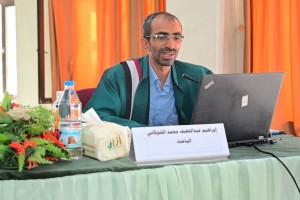
Researcher Saba’a Mohammed Yaya Mubarak Al-Arashani was awarded a Master’s Degree in Translation with a grade of excellent and an average of (95%) for her thesis titled: A Comparative Analysis of Translation Strategies Employed by Specialist and Non-Specialist Translators: A Case Study of the Arabic Translation of Harold F. Jacob’s Kings of Arabia, which was submitted to the Community Center for Translation and Language Teaching (CCTLT), – Sana’a University. The MA defense was held on Thursday, September 17, 2026.

The MA Viva-voce Committee, which was formed based on a resolution issued by the Graduate Studies and Scientific Research Council, consisted of the following:
- Prof. Ibraheem N.A. Tagaddeen – Internal Examiner and Committee Chair.
- Prof. Ali Saleh Al-Haidari – Al-Mahweet University – External Examiner and Committee Member.
- Prof. Abdulwadood Ahmed Annuzaili – Sana’a University – Main Supervisor and Committee Member.
The study examined the translation strategies employed by specialized and non-specialized translators in translating culture-specific items (CSIs) from English into Arabic, using Harold F. Jacob’s Kings of Arabia as a case study.
The study aimed to identify the strategies employed by the translators, compare their effectiveness, and examine the major challenges involved in translating culturally loaded elements. It also explored the possible influence of formal translation expertise and cultural competence on translators’ choices.
The data consisted of thirty extracts selected from Kings of Arabia, covering religious, political, historical, social, and tribal culture‑specific items (CSIs). The published Arabic translation by Ahmed Al‑Mudhwahi—treated in this study as a non‑specialist translator—was compared with three independent translations produced by specialist translators. The analysis was conducted using Aixelá’s (1996) framework of CSIs, applying five operational strategies: Retention, Linguistic Translation, Explanation, Adaptation, and Substitution.
The translations were evaluated in relation to meaning, cultural content, communicative function, naturalness, historical accuracy, and religious authenticity. The findings showed that all four translators employed the five strategies, but differed in how they applied them. Retention, adaptation, and linguistic translation were among the most frequently used strategies across the corpus.
The study further revealed that specialist translators demonstrated greater ability to handle historical and political terminology, often maintaining the structure and meaning of the source text. They also employed explanation to clarify unfamiliar cultural references.
The thesis defense was attended by faculty members, researchers, students, and interested participants as well as the researcher’s colleagues and family members.