
Master’s Degree Awarded to Ms. Areej Abdulmughni in Linguistics

Ms. Areej Ismail Mohammed Abdulmughni was awarded a Master’s Degree in Linguistics with an average of Excellent and a grade of (95%) for her thesis titled: The Use of Hedging Expressions in Conclusion Sections of Science Research Articles Written in English by Yemeni and English Authors, which was submitted to the Department of English Language – Linguistics Program, Faculty of Languages– Sana’a University. The MA defense was held on Thursday, May 14, 2026 .
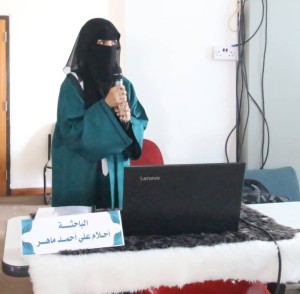
The MA Viva-voce Committee, which was formed based on a resolution issued by the Graduate Studies and Scientific Research Council, consisted of the following:
| # | Committee Members | Designation | Position |
| 1 | Prof. Abdulsalam Mohammed Ghaleb Al-Ghurafi | Internal Examiner | Chair |
| 2 | Prof. Abdulhameed A. Ashujaa | Main Supervisor | Member |
| 3 | Assoc. Prof. Abdullah Ali Mohammed Al-Eryani | External Examiner | Member |
The thesis aimed to:
- Investigate the patterns, functions, and frequencies of hedging expressions used in the conclusion sections of English-language scientific research articles.
- Compare the use of hedging strategies by Yemeni non-native English-speaking researchers and native English-speaking researchers in the fields of chemistry, physics, biology, and medicine.
- Explore whether statistically significant differences exist in the use of hedging expressions between Yemeni and native English-speaking writers.
The study yielded several key findings summarized as follows:
- Yemeni writers used a greater number of hedging expressions in the categories of descriptive hedges and writer-oriented hedges, whereas native English-speaking writers tended to use reliability-oriented hedges more prominently.
- Across disciplines, no statistically significant differences were found between the two groups in chemistry and biology, while clear differences appeared in physics and medicine in favor of the Yemeni writers.
- No statistically significant differences were found in the total distribution of hedging expressions between the two groups, as their overall use appeared largely comparable despite differences in preferences for particular types of hedging strategies.
In light of these findings, the researcher recommended the following:
- Integrating hedging strategies into the teaching of academic writing for undergraduate and postgraduate students.
- Drawing greater attention to the appropriate use of hedging and mitigation expressions according to the conventions and norms of each scientific discipline, given the study’s practical implications for researchers in scientific fields, specialists in English for Academic Purposes (EAP), and curriculum designers.
The defense session was attended by a number of academics, researchers, students, colleagues, and the researcher’s family.