Master’s Degree Awarded to Researcher Salah Ahmed Maudha in English Literature

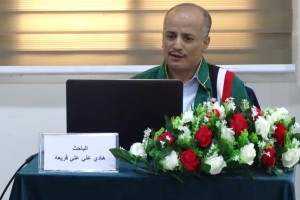
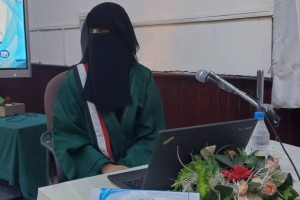
Researcher Salah Ahmed Abdu Maudha was awarded a Master’s Degree in English Literature with a grade of excellent and an average of (95%) for his thesis titled: Identity Construction through Displacement and Trauma: A Critical Study of Selected Palestinian Novels, which was submitted to the Department of English, Faculty of Languages – Sana’a University. The MA defense was held on Thursday, September 10, 2026.

The MA Viva-voce Committee, which was formed based on a resolution issued by the Graduate Studies and Scientific Research Council, consisted of the following:
- Prof. Ibraheem N. A. Tagaddeen – Sana’a University – Main Supervisor and Committee Member.
- Iman Abdullah Al-Mahdi – Sana’a University – Internal Examiner and Committee Chair.
- Prof. Kamal Ismail Al-Jarani – Ibb University – External Examiner and Committee Member.
The thesis examined the construction of Palestinian identity under conditions of forced displacement and psychological trauma across different historical and generational contexts, through a comparative analysis of Ghassan Kanafani’s Men in the Sun and Susan Abulhawa’s Mornings in Jenin.
The thesis revealed two contrasting trajectories in the representation of displacement, fragmented identity, and psychological trauma.
In Men in the Sun, forced displacement is presented not merely as a geographical and material loss, but as an existential rupture that leads to fragmented identity, dehumanization, and ultimately a loss of self. Refugees are thereby reduced to commodities that can be traded within a social and political vacuum characterized by corruption.
In Mornings in Jenin, identity is not presented as a fixed entity destroyed by trauma, but rather as a dynamic, resilient, and resistant project that is continually reconstructed through attachment to the land, memory, and the continuity of narratives across generations. Palestinian identity is thus portrayed as a living force resistant to erasure and capable of continuous renewal despite harsh circumstances and repeated attempts by the Israeli occupation to erase it.
The study concluded that the tragedy of the Palestinian people began with the forced displacement perpetrated by the Zionist movement and continued amid systematic violence, exacerbated by the silence and abandonment of Arab regimes, as well as the indifference of international actors toward this ongoing tragedy.
In light of the findings, the researcher recommended the following:
- Incorporating contemporary Palestinian resistance novels that emerged in the post-Nakba period into comparative literature curricula at universities, particularly in literature departments, with the aim of deconstructing Western dominance over narratives and ideologies and challenging stereotypical Western Orientalist representations of the “Other.”
- Prioritizing the digital archiving of oral testimonies and local records relating to the Palestinian cause, transmitted across generations, by cultural and academic centers and institutes in the Arab and Islamic worlds, in order to counter ongoing attempts at cultural erasure and systematic epistemicide.
- Integrating multidisciplinary frameworks into literary critical studies, drawing on digital humanities, trauma studies, spatial studies, and related theories to analyze how the dynamics of narratives of resilience and resistance vary across contemporary global digital platforms.
- Expanding the translation of prominent works of Palestinian resistance literature into different languages, encompassing a diverse range of such works, with the aim of countering constraints imposed by imperialist and Zionist media.
The thesis defense was attended by faculty members, researchers, students, and interested participants as well as the researcher’s colleagues and family members.