Sana’a – Wednesday, April 29, 2026
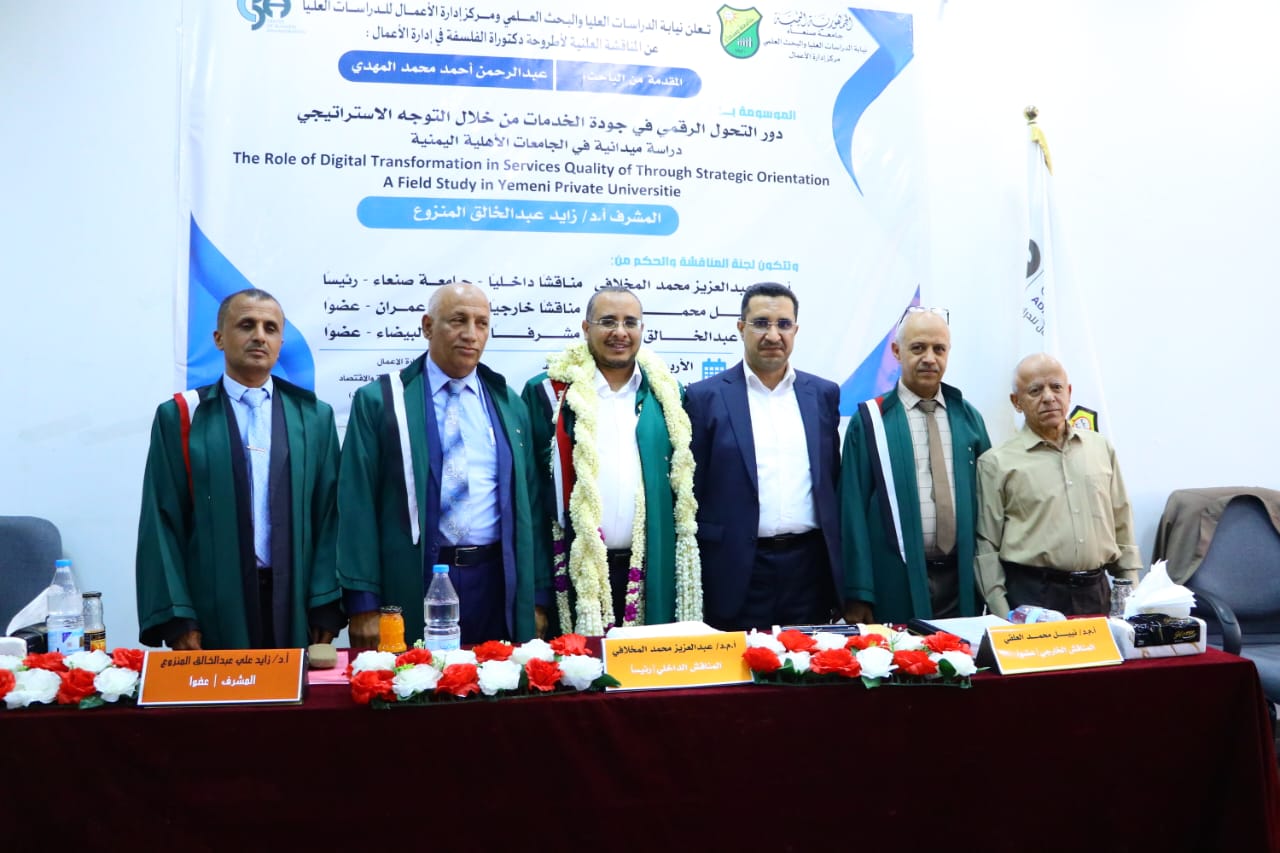
Researcher Abdulrahman Ahmed Mohammed Al-Mahdi was awarded a PhD degree in Business Administration by the Center of Business Administration for Graduate Studies at Sana’a University for his dissertation titled: “The Role of Digital Transformation in Services Quality Through Strategic Orientation: A Field Study in Yemeni Private Universities.”
The PhD Viva-Voce Committee consisted of Assoc. Prof. Dr. Abdulaziz Mohammed Al-Makhlafi, Sana’a University, as Internal Examiner and Chair; Assoc. Prof. Dr. Nabil Mohammed Al-Alfi, Amran University, as External Examiner and Member; and Prof. Dr. Zaid Ali Abdulkhaleq Al-Manzou, Al-Bayda University, as Supervisor and Member.
The dissertation defense was attended by a number of academics, researchers, postgraduate students, and other interested individuals, in addition to the researcher’s colleagues and family members.
The study aimed to investigate the vital role of digital transformation as a key driver of university development, with particular emphasis on service quality as the dependent variable and a decisive outcome representing a key criterion for the survival and competitiveness of Yemeni private universities. The study also examined the mediating role of strategic orientation as a link between the capabilities of digital transformation and the improvement of service quality, in addition to identifying technological and human requirements and structural barriers that limit the effectiveness of digital transformation in the targeted universities.
The study adopted a descriptive-analytical approach and used a questionnaire as the primary data collection instrument. The study population consisted of 1,311 academic and administrative leaders distributed across 35 private universities in the Capital Secretariat, Sana’a. A stratified random sample of 307 valid respondents was selected from leaders in eight targeted universities, based on the Thompson formula. The data were analyzed using SPSS and AMOS, including Structural Equation Modeling (SEM) to test the hypotheses and assess the goodness of fit of the proposed research model.
The study reached several key conclusions, most notably that Yemeni private universities demonstrated high levels of digital readiness and strategic orientation. The findings also established the critical role of transformational leadership as one of the most important drivers of digital transformation, with an influence exceeding that of physical infrastructure.
The mediation analysis demonstrated the effectiveness of strategic orientation in transmitting the effect of digital transformation on service quality. However, this effect operated through organizational goals and values, while no significant mediating effect was found through vision and mission, reflecting a genuine gap between strategic theorizing and operational performance. The study also identified a coordination gap and found that reliance on closed commercial systems hinders the achievement of national digital integration.
Based on these findings, the study recommended integrating digital strategy as an essential component of university identity and investing substantially in digital leadership and human resources. At the national level, it recommended restructuring the General Administration of Systems and Technologies at the Ministry of Education and Scientific Research and activating its supervisory role, while establishing direct coordination with the Ministry of Communications and Information Technology to adopt a unified software framework that moves beyond limited commercial solutions.
The study further recommended developing integrated platforms and establishing a national digital repository to ensure data sovereignty and security, as well as standardizing digital quality standards for higher education institutions in Yemen.