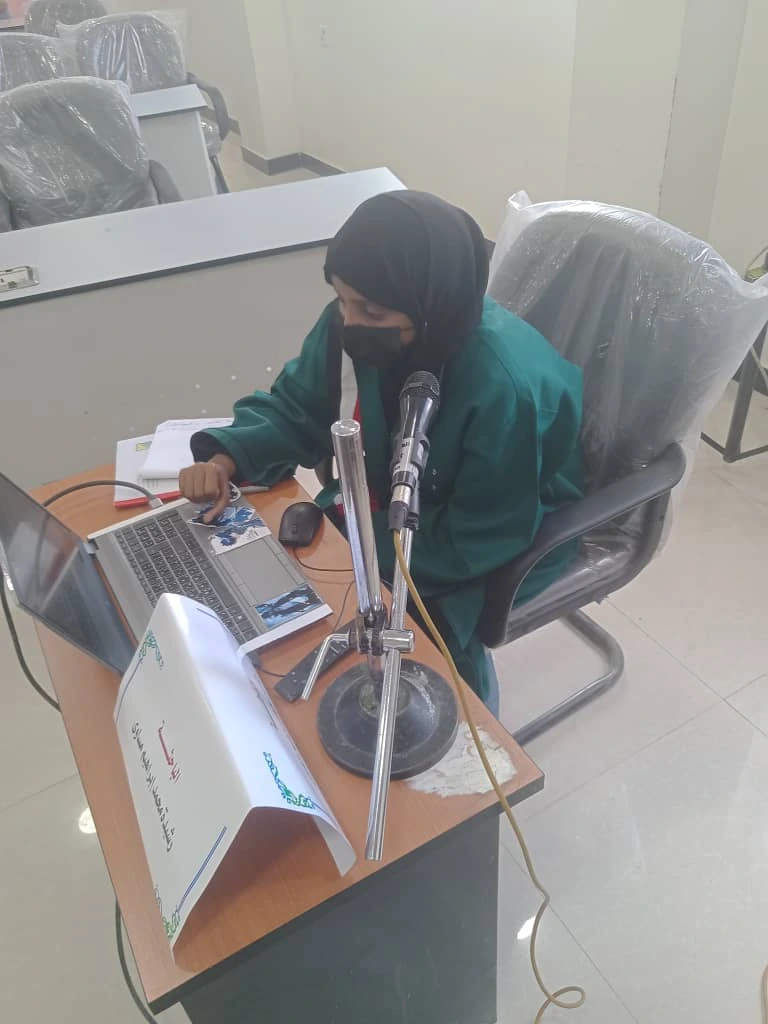
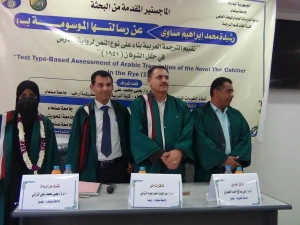
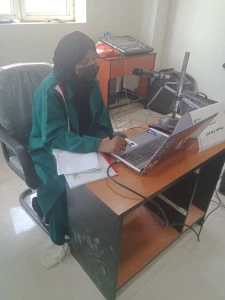
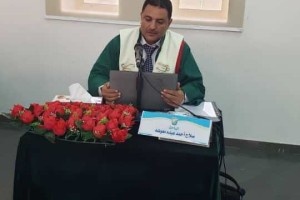
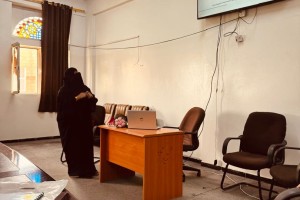
Ms.Rashida Mohammed Ibrahim Mesawawas awarded a Master’s Degree in Translation Studies with an average of Excellent and a grade of (90%)for her thesis titled: Text Type-Based Assessment of Arabic Translation of the Novel The Catcher in the Rye (1951),which was submitted tothe Department of Translation, Faculty of Languages – Sana’a University. The MA defense was held on Sunday, April 12, 2026.
The MA Viva-voce Committee, which was formed based on a resolution issued by the Graduate Studies and Scientific Research Council, consisted of the following:
#
Committee Members
Designation
Position
1
Assoc. Prof. Abdulwadood Ahmed Annuzaili
Internal Examiner
Chair
2
Assoc. Prof. Yahya Mohammed Ali Al-Marani
Main Supervisor
Member
3
Assoc. Prof. Ali Saleh Ahmed Al-Haidari
External Examiner
Member
The thesis aimed to:
Evaluate the quality of the Arabic translation of The Catcher in the Rye (1951) by J. D. Salinger in light of the model proposed by Christiane Nord (2000).
Identify translation deficiencies at the semantic, syntactic, stylistic, and lexical levels using the same model.
The study yielded several key findings summarized as follows:
Numerous deficiencies were identified in selected segments of the source text and the target text when compared using Nord’s model.
The analysis revealed multiple mismatches that hindered comprehension of the themes and intended messages of the original text.
The overall quality assessment indicated a significant divergence between the translated text and the source text.
In light of these findings, the researcher recommended the following:
Avoiding literal translation and striving to convey the aesthetics and message of the source text more faithfully.
Applying systematic methods of translation quality assessment to literary translations in order to detect mismatches and errors.
The defense session was attended by a number of academics, researchers, students, colleagues, and the researcher’s family.