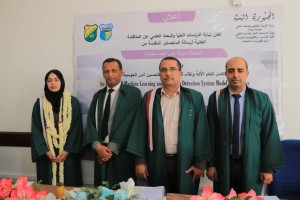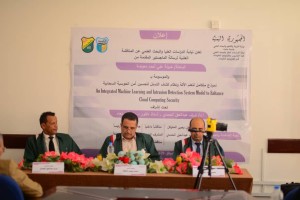
Master’s Degree Awarded to Ms. Khawla Abdullah in Information Technology
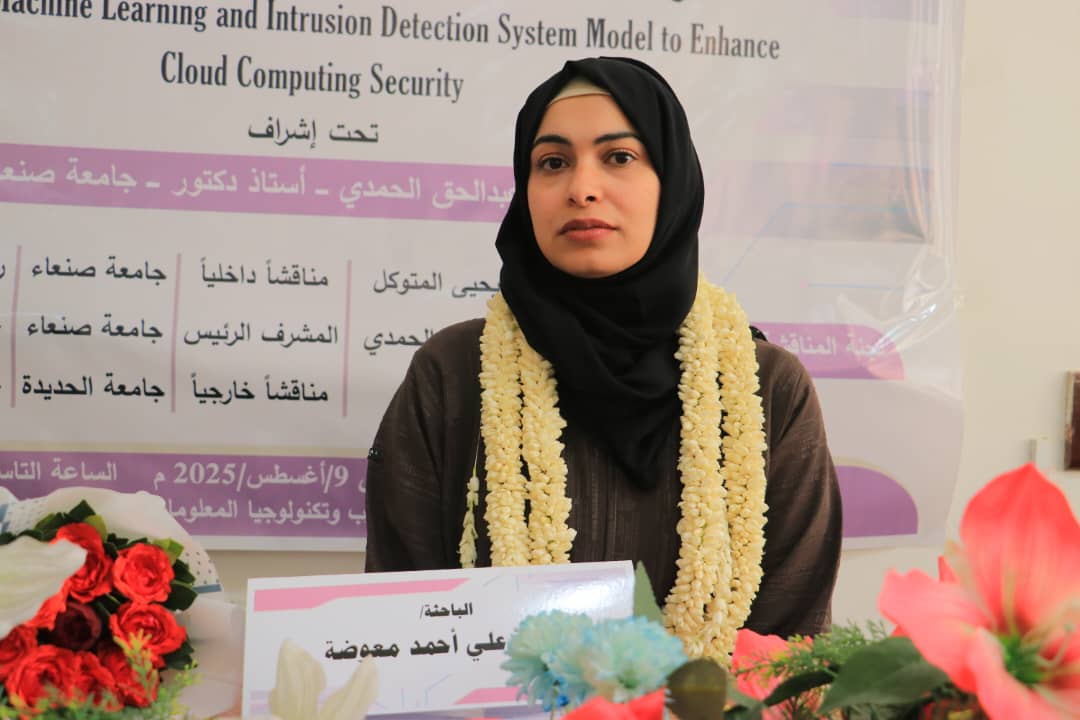
Ms. Khawla Ali Ahmed Abdullah was awarded a Master’s degree in Information Technology for her thesis titled “An Integrated Machine Learning and Intrusion Detection System Model for Enhancing Cloud Computing Security,” which was submitted to Faculty of Computer and Information Technology – Sana’a University. The defense was held on 09-08-2025.
The MA Viva-voce Committee, which was formed based on a resolution issued by the Post-Graduate Studies and Scientific Research Council, consisted of the following members:
- Main Supervisor: Prof. Sharaf Al-Hamdi
- Internal Examiner and Chair: Prof. Adnan Al-Mutawakil
- External Examiner: Prof. Jamil Rashed Qaed
The thesis aimed to develop an integrated machine learning-based intrusion detection model to enhance cloud computing security. This was achieved by identifying research gaps, utilizing appropriate machine learning algorithms, developing a comprehensive model that combines machine learning algorithms with feature selection methods, and evaluating its performance using standard datasets. The goal was to achieve a high detection rate, improved accuracy, and a low false alarm rate.
The thesis reached several conclusions, including:
- Improved Cloud Security: The integration of Intrusion Detection Systems (IDS) with Machine Learning (ML) techniques significantly enhances threat detection capabilities.
- Research Findings: The use of NSL-KDD and UNSW-NB15 datasets showed that ensemble models (such as DT+RF+GB and DT+RF+SVM) outperform individual classifiers, with accuracy reaching up to 100%.
- Feature Selection: Information-based feature selection techniques maintained high accuracy and increased computational efficiency.
- Importance of Hybrid Selection: Models relying solely on specific features, such as RF, showed a decline in performance.
The researcher also presented several recommendations in her thesis, including:
- Prioritize Ensemble Methods: Use models like DT+RF+GB to achieve an optimal balance between accuracy and flexibility.
- Employ Hybrid Feature Selection: Combine human and statistical methods to reduce features while maintaining accuracy.
- Avoid Over-reliance on NB with Limited Features: Performance deteriorates with certain feature choices.
- Improve Dataset Characteristics: Adjust feature selection and models based on the characteristics of the data used.
- Future Research: Explore deep learning and hybrid techniques on these datasets and evaluate their potential application in real-world scenarios.
The thesis was examined and recommended by the Viva-Voce Committee for acceptance and approval. The defense was attended by a number of academics, researchers, interested individuals, in addition to the candidate’s colleagues and family members.