Master’s Degree Awarded to Mr. Najd Abdullah Najad in International Development

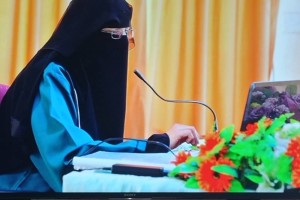
Mr. Najd Abdullah Mohammed Najad was awarded a Master’s degree in the major of International Development with an average of (Excellent) for his thesis titled, “The Role of Humanitarian Organizations in Addressing Basic Educational Needs for Internally Displaced Persons (IDPs): A Case Study of Abs District, Hajjah Governorate,” which was submitted to the Inclusive Development Research Center- Sana’a University. The defense was held on Tuesday, March 10, 2026.
The MA Viva-voce Committee, which was formed based on a resolution issued by the Post-Graduate Studies and Scientific Research Council, consisted of the following:
1 Prof. Abdulsalam Ahmed Al-Dar, External Examiner, Taiz University, Chair.
2 Assoc. Prof. Sukaina Ahmed Hashem, Internal Examiner, Sana’a University, Member.
3 Assoc. Prof. Abdulwahab Yahya Abdulqader, Main Supervisor, Sana’a University, Member.
4 Dr. Suhair Ali Atef, Co-supervisor, Sana’a University, Member.
The study aimed to evaluate the role of humanitarian organizations in addressing the basic educational needs of Internally Displaced Persons (IDPs) in Yemen. Using Abs District in Hajjah Governorate as a case study, the study analyzed the contributions of United Nations agencies, international NGOs, and local non-governmental organizations in supporting the education sector. The focus on Abs District is particularly significant as it remains one of the regions most severely impacted by displacement and the escalating humanitarian crisis that has gripped the country since 2015.
The study key findings include:
- Organizations improved school environments, provided essential supplies, furniture, and supported extracurricular educational activities.
- During the research period, educational interventions were implemented in 77 schools within Abs District by 12 different humanitarian organizations.
- A total of 37,125 individuals benefited from these projects, including 3,366 displaced students and 599 male and female teachers who received direct support.
The study concluded with the following recommendations:
- The study emphasizes the necessity of strengthening synergy and integration between humanitarian organizations, educational authorities, and local governance.
- A strategic shift is required, moving from short-term emergency response logic to a comprehensive and sustainable educational track.
- Future interventions should link infrastructure development with teacher training and the provision of Psychosocial Support (PSS).
- All programs must strictly commit to the Minimum Standards for Education in Emergencies (EiE) to ensure both the continuity and quality of learning for displaced children in displacement environments.
The study was examined and recommended by the MA Viva-Voce Committee for acceptance and approval. The defense was attended by a number of academics, researchers, students, and interested individuals, in addition to the candidate’s colleagues and family members.