
Sana’a, Yemen – Wednesday, May 20, 2026
The Center of Business Administration at Sana’a University today hosted a seminar for PhD candidate Mr. Ali Yahya Mohammed Fadhail, who presented his dissertation proposal titled: “The Role of Strategic Agility in Achieving Entrepreneurial Performance through Sustainable Human Resource Management: A Field Study in Industrial Companies of the Hail Saeed Anam Group & Partners.” The dissertation is being supervised by Assoc. Prof. Zayed Al-Maznooa (Supervisor).
The PhD dissertation proposal viva-voce committee consisted of the following:
• Prof. Sinan Ghalib Al-Marhadi, Professor of Business Administration – Chair and Examiner.
• Assoc. Prof. Zayed Al-Maznooa, Associate Professor of Business Administration – Supervisor and Member.
• Assoc. Prof. Fadhl Al-Mahmoudi, Associate Professor of Business Administration – Member.
• Assoc. Prof. Ali Al-Hamdi, Associate Professor of Business Administration – Member.
During the session, the researcher outlined his proposed study, detailing its objectives, significance, methodology, and the theoretical and conceptual framework it will build upon. He also presented his proposed hypotheses and analytical tools.
Following a comprehensive discussion, the committee approved the PhD dissertation proposal, commending the researcher’s efforts and acknowledging the importance of the study in enhancing entrepreneurial performance in the industrial sector.
Sana’a, Yemen – Wednesday, May 20, 2026
The Center of Business Administration at Sana’a University today hosted a seminar for PhD candidate Mr. Abdulkarim Dahan Saleh Al-Houshali, who presented his dissertation proposal titled: “The Role of Digital Leadership in Institutional Performance through Digital Transformation: A Field Study on Food Industry Companies of the Hail Saeed Anam Group.” The dissertation is being supervised by Prof. Sinan Ghalib Al-Marhadi (Supervisor).
The PhD dissertation proposal viva-voce committee consisted of the following:
• Assoc. Prof. Abdulaziz Al-Makhlaafi – Chair and Examiner.
• Assoc. Prof. Hamoud Aqlan – Member.
• Assoc. Prof. Foad Al-Makhlaafi – Member.
• Prof. Sinan Ghalib Al-Marhadi – Supervisor and Member.
During the session, the researcher outlined his proposed study, detailing its objectives, significance, methodology, and the theoretical and conceptual framework it will build upon. He also presented his proposed hypotheses and analytical tools.
Following a comprehensive discussion, the committee approved the PhD dissertation proposal, commending the researcher’s efforts and acknowledging the importance of the study in contributing to both academic and practical development in the food industry sector.
Sana’a, Yemen – Wednesday, May 20, 2026
The Center of Business Administration at Sana’a University today hosted a seminar for PhD candidate Mr. Fouad Abdullah Abdullah Aburas, who presented his dissertation proposal titled: “The Impact of Strategic Foresight on Institutional Performance through Strategic Agility: A Field Study on Industrial Sector Companies in Yemen.” The dissertation is being supervised by Assoc. Prof. Ahmed Al-Sanbani (Supervisor).
The PhD dissertation proposal viva-voce committee consisted of the following:
• Assoc. Prof. Hamoud Aqlan – Chair and Examiner.
• Assoc. Prof. Abdulrazzaq Al-Marani – Member.
• Assoc. Prof. Ahmed Huraira – Member.
• Assoc. Prof. Tawfiq Al-Sanbani – Supervisor and Member.
During the session, the researcher outlined his proposed study, detailing its objectives, significance, methodology, and the theoretical and conceptual framework upon which it is based. He also presented his proposed hypotheses and analytical tools.
Following a comprehensive discussion, the committee approved the PhD dissertation proposal, commending the researcher’s efforts and acknowledging the importance of the study in contributing to both academic and practical aspects.
Sana’a – Saturday, May 9, 2026
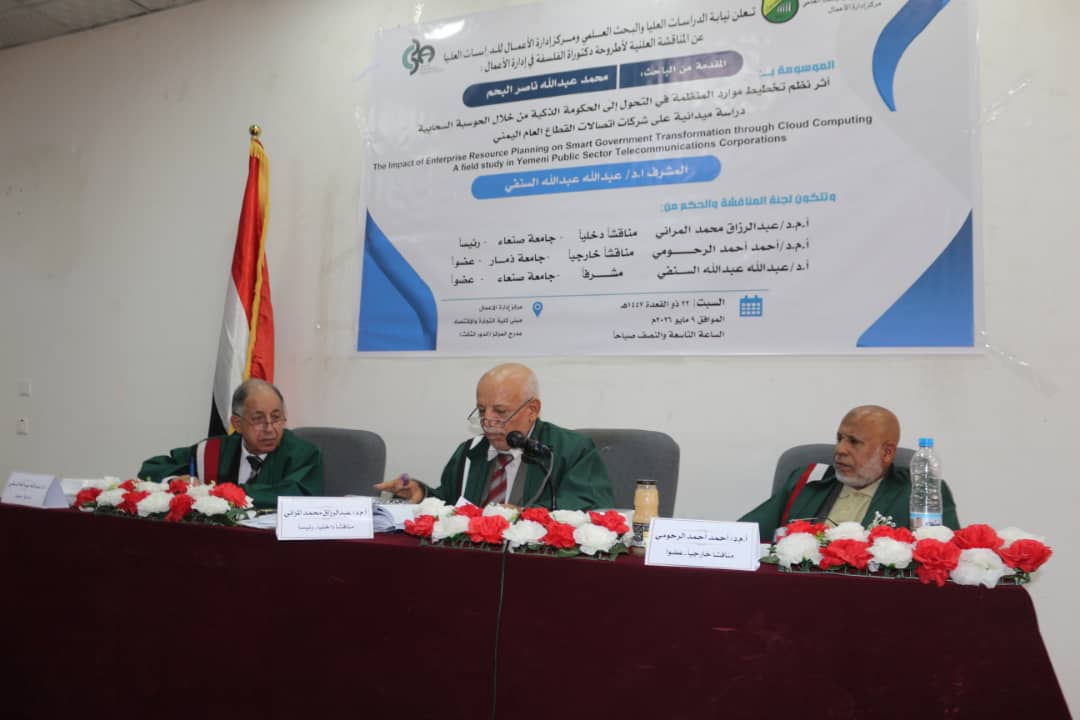
Researcher Mohammed Abdullah Nasser Al-Bahm was awarded a PhD degree in Business Administration by the Center of Business Administration for Graduate Studies at Sana’a University for his dissertation titled: “The Impact of Enterprise Resource Planning Systems on the Transition to Smart Government Through Cloud Computing: A Field Study of Yemeni Public-Sector Telecommunications Companies.”
The PhD Viva-Voce Committee consisted of Assoc. Prof. Dr. Abdulrazzaq Al-Marani, Sana’a University, as Internal Examiner and Chair; Assoc. Prof. Dr. Ahmed Al-Rahoumi, Dhamar University, as External Examiner and Member; and Prof. Dr. Abdullah Abdullah Al-Sanfi, Sana’a University, as Supervisor’s Representative and Member.
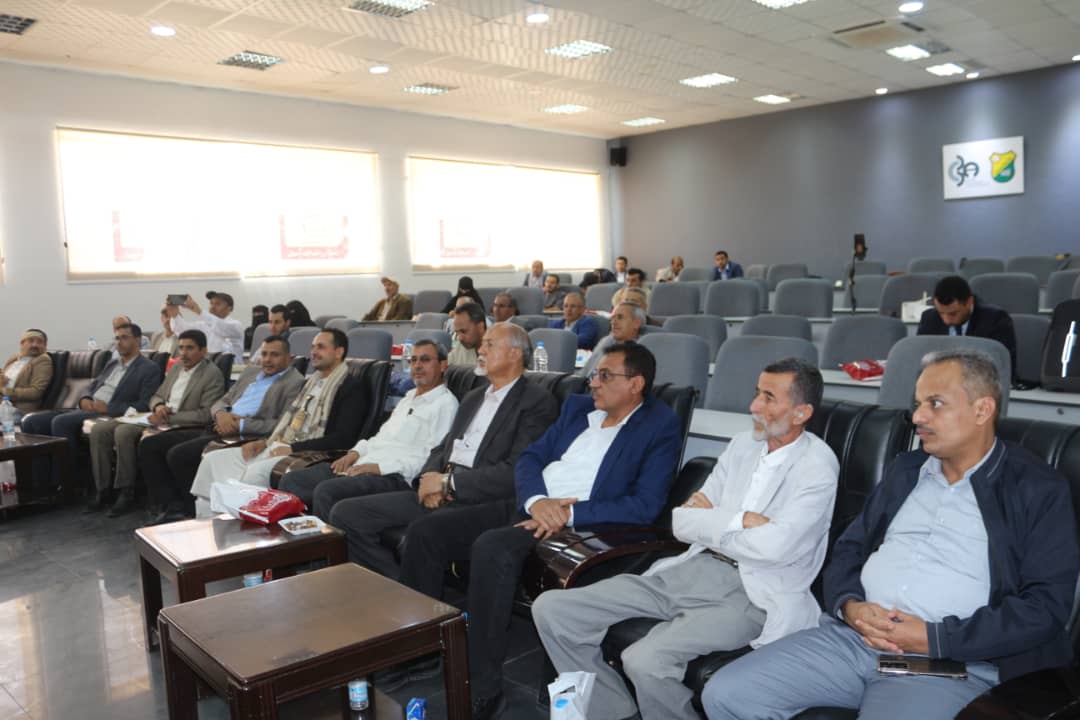
The dissertation defense was attended by a number of academics, researchers, postgraduate students, and other interested individuals, in addition to the researcher’s colleagues and family members.
The study aimed to measure the impact of Enterprise Resource Planning (ERP) systems on the transition to smart government through cloud computing, as well as to determine the levels of ERP system implementation, cloud computing adoption, and smart government implementation in Yemeni public-sector telecommunications companies.
The study adopted a descriptive-analytical approach and used a questionnaire as the primary data collection instrument. The study population consisted of 177 employees who use ERP systems, software and applications, as well as cloud computing service providers and technical and technological support personnel in the companies under study. Given the relatively small population and the availability of comprehensive data on all its members, a census approach was adopted. A total of 177 questionnaires were distributed, of which 157 valid questionnaires were retrieved, representing a response rate of 89.0%.
The study data were analyzed using Partial Least Squares Structural Equation Modeling (PLS-SEM) through SmartPLS, in order to test the study’s hierarchical model at two levels by evaluating both the measurement model and the structural model.
The study reached several findings, most notably that ERP systems have a significant effect on the transition to smart government through cloud computing. The findings also demonstrated significant effects of ERP systems on the transition to smart government and on the adoption of cloud computing, as well as a significant effect of cloud computing on the transition to smart government in Yemeni public-sector telecommunications companies.
The findings further indicated that the levels of implementation of the study variables—ERP systems, cloud computing, and smart government—in Yemeni public-sector telecommunications companies were at the lower end of the high level.
The study presented several recommendations, most notably that Yemeni public-sector telecommunications companies should focus on adopting new generations of ERP systems or developing the capabilities of their existing systems to incorporate supplier relationship management, customer relationship management, business intelligence, and mobile commerce. The systems should also support operations through smartphones, tablets, and social media, automate business processes, organizational information and services, make these systems accessible to all employees, and provide employees with appropriate training on their components.
The study also recommended that Yemeni public-sector telecommunications companies provide financial, technological, and human-resource support to the national cloud computing operator, Sahbcom, enabling it to provide various cloud computing services—including infrastructure, platforms, software, and information—to individuals and organizations for appropriate fees. It further recommended encouraging developers and programmers to build digital platforms and smart applications and deploy them in the cloud environment.
Finally, the study recommended that Yemeni public-sector telecommunications companies develop a strategic plan for transitioning to smart government, allocate the necessary financial, technological, and human resources, and complete the required legal, regulatory, and administrative arrangements. It also recommended leveraging the widespread use of applications, smartphones, and digital technologies by broad segments of society to provide services and information and facilitate transactions.
Sana’a – Monday, May 4, 2026
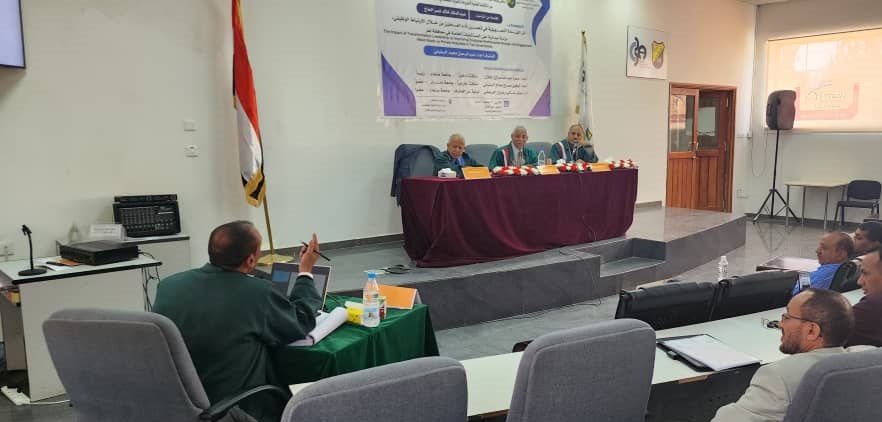
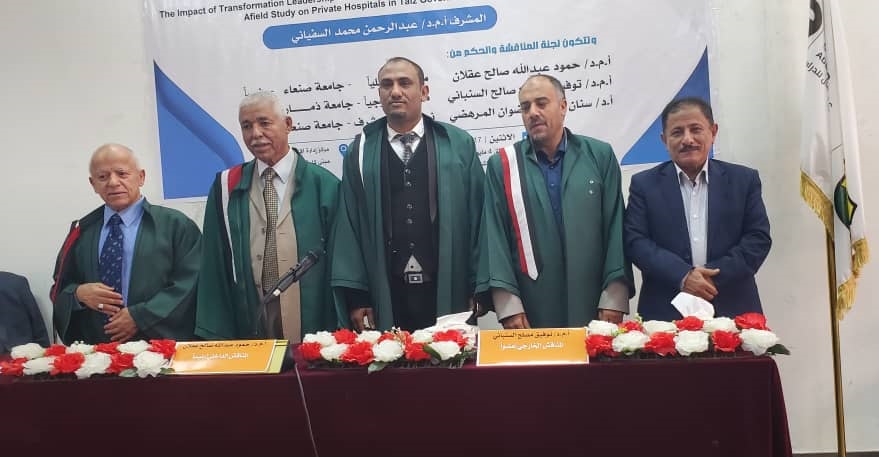
Researcher Abdulmalik Khaled Nasr Al-Hajj was awarded a PhD degree in Business Administration by the Center of Business Administration for Graduate Studies at Sana’a University for his dissertation titled: “The Impact of Transformational Leadership on Improving Employee Performance Through Work Engagement: A Field Study of Private Hospitals in Taiz Governorate.” The dissertation was supervised by Assoc. Prof. Dr. Abdulrahman Mohammed Ahmed Al-Sufyani.
The PhD Viva-Voce Committee consisted of Assoc. Prof. Dr. Hamoud Abdullah Saleh Aqlan, Sana’a University, as Internal Examiner and Chair; Assoc. Prof. Dr. Tawfiq Musleh Saleh Al-Sanbani, Dhamar University, as External Examiner and Member; and Prof. Dr. Sinan Ghaleb Al-Marhadi, Sana’a University, representing the Supervisor and serving as a Member.
The dissertation defense was attended by a number of academics, researchers, postgraduate students, and other interested individuals, in addition to the researcher’s colleagues and family members.
The study aimed to assess the current level of transformational leadership practices in private hospitals in Taiz Governorate, as well as the levels of employee performance improvement and work engagement among employees in the hospitals under study. It also examined the effects of transformational leadership, both collectively and individually through its dimensions of idealized influence, inspirational motivation, intellectual stimulation, and individualized consideration, on employee performance and work engagement. Furthermore, the study investigated the effect of work engagement on employee performance and examined the effect of transformational leadership on employee performance through work engagement as a mediating variable.
The study population consisted of 708 employees, including administrators, physicians, and technical staff working across 13 private hospitals in Taiz Governorate. A stratified random sample of 249 respondents was selected, of which 228 valid questionnaires were used for statistical analysis. The study adopted a descriptive approach, and the data were analyzed using the Statistical Package for the Social Sciences (SPSS) and AMOS.
The study reached several findings, most notably that the levels of transformational leadership practices, employee performance improvement, and work engagement in the hospitals under study were all high.
The findings also showed a statistically significant effect of transformational leadership, as a composite construct, on employee performance. At the dimensional level, inspirational motivation and intellectual stimulation had positive effects on employee performance, whereas idealized influence and individualized consideration did not have statistically significant effects.
Furthermore, transformational leadership as a composite construct had a statistically significant effect on work engagement. Intellectual stimulation, inspirational motivation, and individualized consideration had positive effects on work engagement, while idealized influence did not have a significant effect.
The findings also demonstrated a statistically significant effect of work engagement on employee performance. Among its dimensions, dedication and absorption had positive effects on employee performance, whereas vigor did not have a statistically significant effect. In addition, the study confirmed a statistically significant effect of transformational leadership on employee performance through work engagement as a mediating variable in private hospitals in Taiz Governorate.
The study recommended strengthening the transformational leadership approach in private hospitals in Taiz Governorate due to its positive contribution to enhancing employee work engagement. It also recommended strengthening the role of work engagement, particularly dedication and absorption, as they have a direct influence on employee performance. Enhancing these aspects would contribute to improving employee performance and strengthening hospitals’ ability to respond effectively to competitive challenges and environmental and epidemiological changes.
Sana’a – Wednesday, April 29, 2026
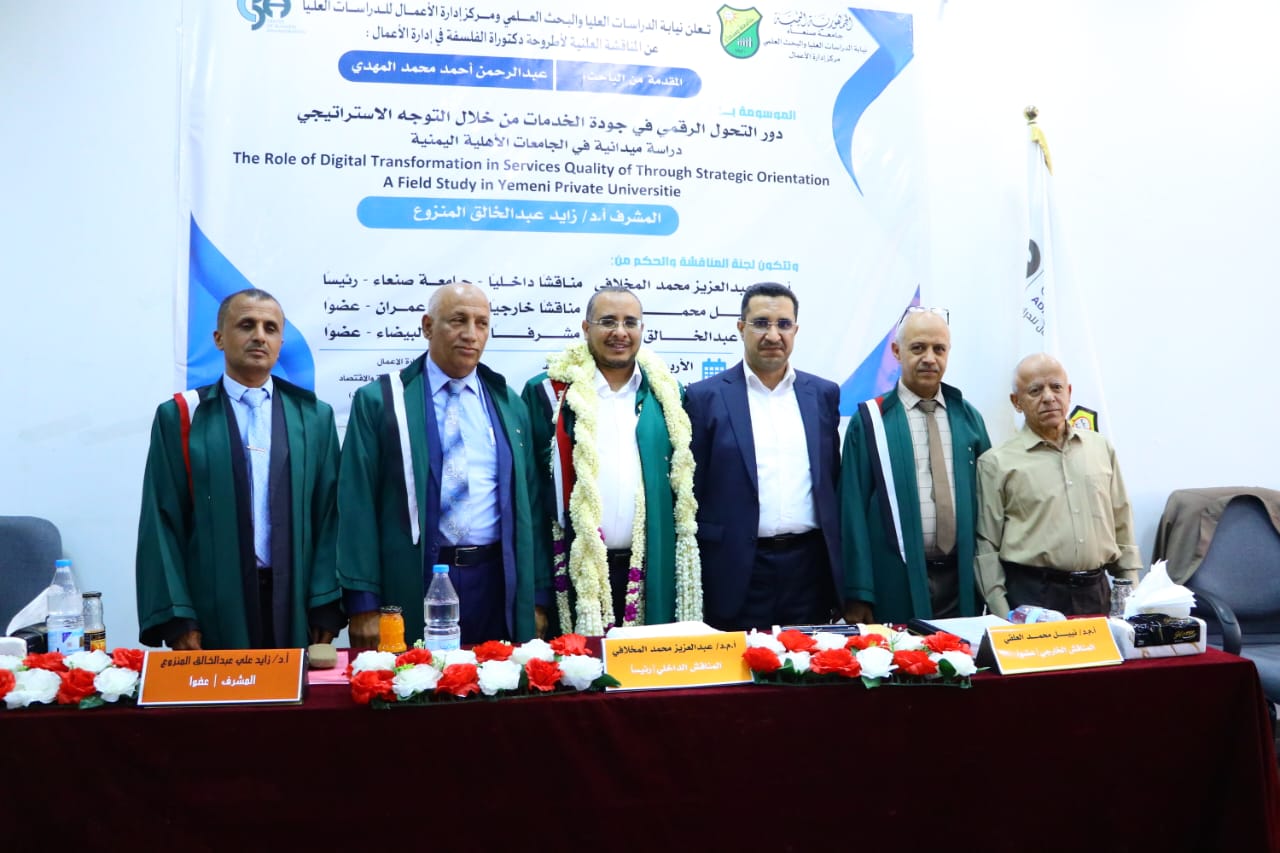
Researcher Abdulrahman Ahmed Mohammed Al-Mahdi was awarded a PhD degree in Business Administration by the Center of Business Administration for Graduate Studies at Sana’a University for his dissertation titled: “The Role of Digital Transformation in Services Quality Through Strategic Orientation: A Field Study in Yemeni Private Universities.”
The PhD Viva-Voce Committee consisted of Assoc. Prof. Dr. Abdulaziz Mohammed Al-Makhlafi, Sana’a University, as Internal Examiner and Chair; Assoc. Prof. Dr. Nabil Mohammed Al-Alfi, Amran University, as External Examiner and Member; and Prof. Dr. Zaid Ali Abdulkhaleq Al-Manzou, Al-Bayda University, as Supervisor and Member.
The dissertation defense was attended by a number of academics, researchers, postgraduate students, and other interested individuals, in addition to the researcher’s colleagues and family members.
The study aimed to investigate the vital role of digital transformation as a key driver of university development, with particular emphasis on service quality as the dependent variable and a decisive outcome representing a key criterion for the survival and competitiveness of Yemeni private universities. The study also examined the mediating role of strategic orientation as a link between the capabilities of digital transformation and the improvement of service quality, in addition to identifying technological and human requirements and structural barriers that limit the effectiveness of digital transformation in the targeted universities.
The study adopted a descriptive-analytical approach and used a questionnaire as the primary data collection instrument. The study population consisted of 1,311 academic and administrative leaders distributed across 35 private universities in the Capital Secretariat, Sana’a. A stratified random sample of 307 valid respondents was selected from leaders in eight targeted universities, based on the Thompson formula. The data were analyzed using SPSS and AMOS, including Structural Equation Modeling (SEM) to test the hypotheses and assess the goodness of fit of the proposed research model.
The study reached several key conclusions, most notably that Yemeni private universities demonstrated high levels of digital readiness and strategic orientation. The findings also established the critical role of transformational leadership as one of the most important drivers of digital transformation, with an influence exceeding that of physical infrastructure.
The mediation analysis demonstrated the effectiveness of strategic orientation in transmitting the effect of digital transformation on service quality. However, this effect operated through organizational goals and values, while no significant mediating effect was found through vision and mission, reflecting a genuine gap between strategic theorizing and operational performance. The study also identified a coordination gap and found that reliance on closed commercial systems hinders the achievement of national digital integration.
Based on these findings, the study recommended integrating digital strategy as an essential component of university identity and investing substantially in digital leadership and human resources. At the national level, it recommended restructuring the General Administration of Systems and Technologies at the Ministry of Education and Scientific Research and activating its supervisory role, while establishing direct coordination with the Ministry of Communications and Information Technology to adopt a unified software framework that moves beyond limited commercial solutions.
The study further recommended developing integrated platforms and establishing a national digital repository to ensure data sovereignty and security, as well as standardizing digital quality standards for higher education institutions in Yemen.
Sana’a – Monday,April 27, 2026
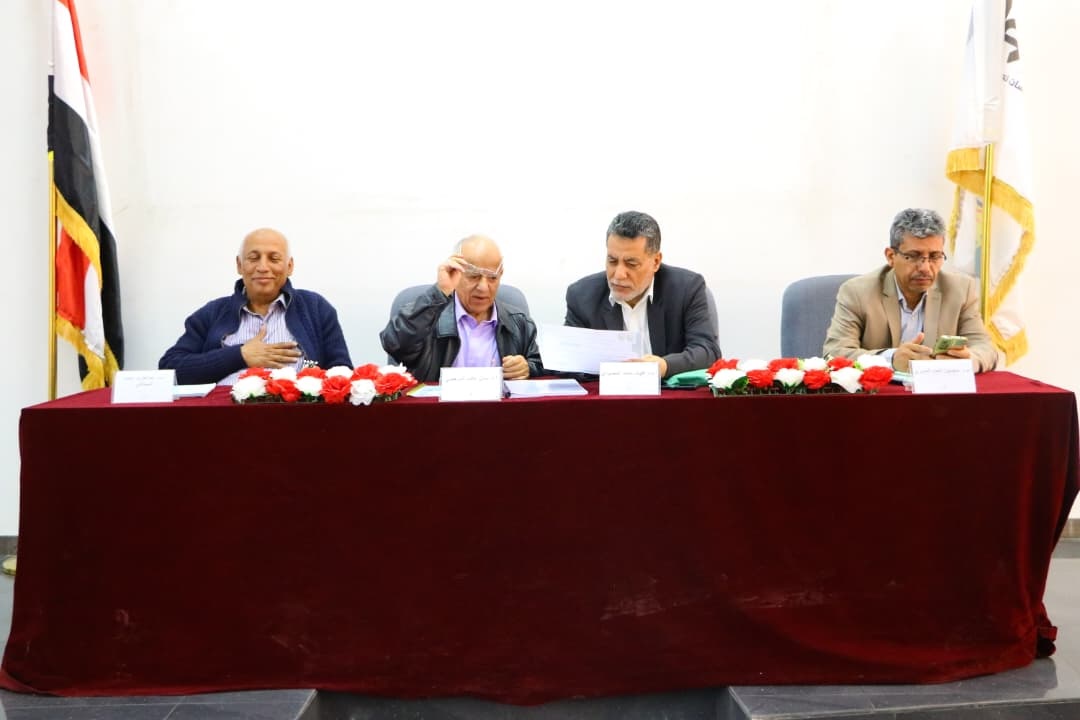
Researcher Hussein Abdullah Mohammed Al-Moayed was awarded a PhD degree in Business Administration by the Center of Business Administration for Graduate Studies at Sana’a University for his dissertation titled: “The Role of Intellectual Capital in Achieving Strategic Success Through Innovative Leadership: A Field Study of Hayel Saeed Anam Group.” The dissertation was supervised by Prof. Dr. Abdullah Abdullah Al-Sanfi.
The PhD Viva-Voce Committee consisted of Prof. Dr. Zaid Ali Abdulkhaleq Al-Manzou, as External Examiner and Chair; Assoc. Prof. Dr. Abdulrazzaq Al-Marani, as Internal Examiner and Member; and Prof. Dr. Abdullah Abdullah Al-Sanfi, as Supervisor and Member.
The study aimed to examine the role of intellectual capital, through its dimensions of human capital, structural capital, and relational capital, in achieving strategic success through innovative leadership, represented by foresight, communication, and development, in Hayel Saeed Anam Group in the Capital Secretariat, Sana’a. Strategic success was examined through the dimensions of survival, adaptation, and growth.
The study adopted a descriptive-analytical approach and used both questionnaires and interviews as data collection instruments. The study population consisted of leaders of the group’s companies located in the Capital Secretariat. A comprehensive survey was conducted, targeting 207 leaders across 12 commercial, service, and industrial companies. The quantitative data were analyzed using SPSS V28, while Structural Equation Modeling was conducted using SmartPLS V4.08.6. Thematic analysis was also employed to analyze the qualitative data collected through interviews.
The findings revealed high levels of intellectual capital, innovative leadership, and strategic success within Hayel Saeed Anam Group.
The study also found a strong and statistically significant mediating role of innovative leadership in the relationship between intellectual capital and strategic success. The dimensions of foresight and communication also demonstrated mediating roles, whereas the development dimension did not have a statistically significant mediating role.
The findings further demonstrated a strong and statistically significant positive role of intellectual capital in achieving strategic success. Relational capital was found to have a significant role in achieving strategic success, whereas human capital and structural capital did not demonstrate statistically significant roles. The findings also showed a strong and statistically significant positive role of intellectual capital in innovative leadership, with significant roles for structural capital and relational capital, while human capital did not have a statistically significant role.
Furthermore, the study found a strong and statistically significant positive role of innovative leadership in achieving strategic success. The dimensions of foresight and communication demonstrated significant roles, whereas the development dimension did not have a statistically significant role.
Based on the findings, the study recommended placing particular emphasis on strengthening and developing relational capital within the group, while continuing to invest in human and structural capital to achieve greater balance in managing intellectual capital. It also recommended developing an integrated system to ensure alignment between intellectual capital investments and the group’s strategic objectives.
The study further recommended adopting an integrated approach to innovative leadership by adapting leadership strategies to place greater emphasis on strategic foresight and effective communication skills among leaders, while continuing to address development aspects. It also recommended enhancing strategic flexibility to address challenges that hinder strategic success by adopting flexible and adaptable strategies based on continuous monitoring of the external environment and strengthening internal capabilities to deal with crises and instability.
The dissertation defense was attended by a number of academics, researchers, postgraduate students, and other interested individuals, in addition to the researcher’s colleagues and family members.
Date: March 7, 2026
Sana’a, Yemen – Saturday, March 7, 2026 –
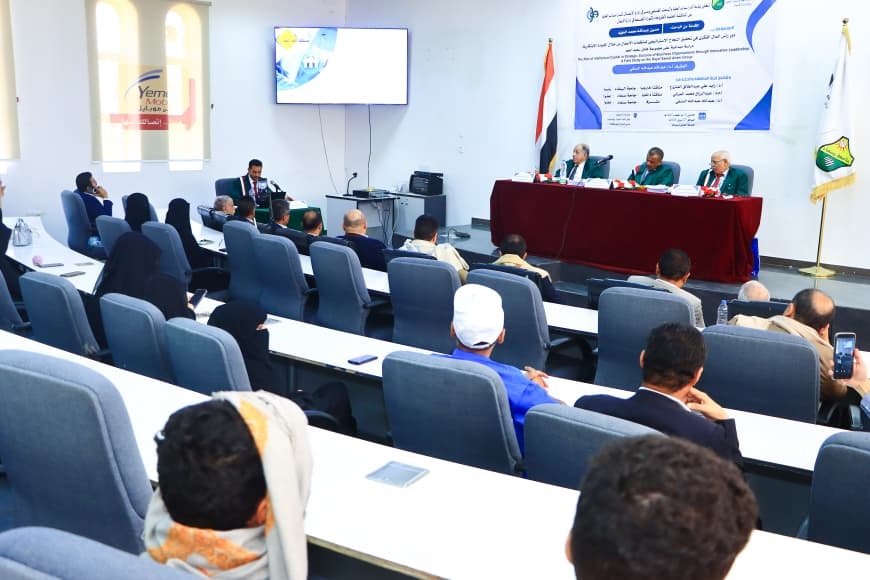
The Center of Business Administration at Sana’a University today hosted a seminar for PhD candidate Mr. Mohammed Ahmed Ghalib Saeed, who presented his dissertation proposal titled: “The Role of Organizational Resilience in Business Continuity Through Strategic Intelligence.” The dissertation is being supervised by Assoc. Prof. Abdulaziz Mohammed Al-Mekhlafi, Associate Professor of Business Administration at Sana’a University.
The PhD dissertation proposal viva-voce committee consisted of the following:
• Prof. Sinan Ghalib Al-Marhadi, Professor of Business Administration, Faculty of Commerce and Economics, Sana’a University, Committee Chair and Member.
• Assoc. Prof. Fadhl Mohammed Al-Mahmoudi, Associate Professor of Business Administration, Faculty of Commerce and Economics, Sana’a University, Committee Member.
• Assoc. Prof. Abdulaziz Mohammed Al-Mekhlafi, Associate Professor of Business Administration, Faculty of Commerce and Economics, Sana’a University, Supervisor and Committee Member.
• Assoc. Prof. Mansour Al-Ameri, Associate Professor of Statistics, Faculty of Commerce and Economics, Sana’a University, Committee Member.
During the session, the researcher outlined his proposed study, detailing its objectives and significance, as well as the theoretical and conceptual framework upon which the study will be based. He also presented the proposed hypotheses, methodology, research instruments, and analytical methods.
Following a comprehensive discussion, the committee approved the PhD dissertation proposal, commending the researcher’s efforts and recognizing the importance of the study and its expected contribution to both academic and practical aspects.
The seminar was attended by a number of interested faculty members and postgraduate students from the Center of Business Administration.
Sana’a – Tuesday, 29 Sha’ban 1447 AH, corresponding to February 17, 2026
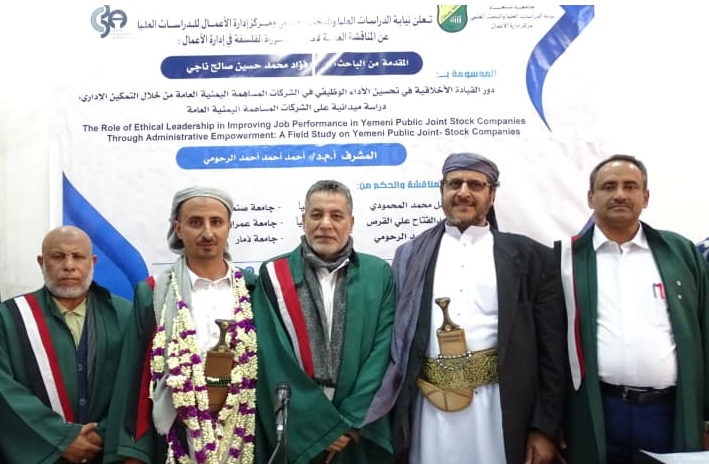
Researcher Fouad Mohammed Hussein Saleh Naji was awarded a PhD degree in Business Administration by the Center of Business Administration for Graduate Studies at Sana’a University for his dissertation titled: “The Role of Ethical Leadership in Improving Job Performance in Yemeni Public Joint Stock Companies Through Administrative Empowerment: A Field Study of Yemeni Public Joint Stock Companies.” The dissertation was supervised by Assoc. Prof. Dr. Ahmed Ahmed Ahmed Al-Rahoumi.
The PhD Viva-Voce Committee consisted of Assoc. Prof. Dr. Fadl Mohammed Al-Mahmoudi, Sana’a University, as Internal Examiner and Chair; Assoc. Prof. Dr. Abdul-Fattah Ali Al-Qurs, Amran University, as External Examiner and Member; and Assoc. Prof. Dr. Ahmed Ahmed Ahmed Al-Rahoumi, Dhamar University, as Supervisor and Member.
The study aimed to examine the role of ethical leadership, through its dimensions of ethical behavior availability, ethical behavior practices, and ethical behavior reinforcement, in improving job performance through its dimensions of knowledge of job requirements, quantity of work completed, quality of work, perseverance, and dependability, through administrative empowerment represented by delegation of authority, teamwork, training, participation, and motivation. The study was conducted on Yemeni public joint stock companies.
The study adopted a descriptive-analytical approach and used a questionnaire as the primary data collection instrument. The data were analyzed using the Statistical Package for the Social Sciences (SPSS 27) and AMOS 27. Through a comprehensive survey, the study targeted all Yemeni public joint stock companies in the Republic of Yemen. The study population consisted of 1,970 individuals, from which a stratified random sample of 433 employees was selected.
The study reached several findings, most notably the existence of a mediating role of administrative empowerment in the relationship between ethical leadership and job performance in the Yemeni public joint stock companies under study. This finding highlights the importance of administrative empowerment in strengthening the effect of ethical leadership on improving job performance.
The study recommended maintaining continuous attention to improving job performance in both quantity and quality, developing employees’ skills, and strengthening their perseverance by promoting ethical values and practices among the leaders of Yemeni public joint stock companies. It also recommended empowering employees by involving them in decision-making, motivating and training them to improve job performance, and strengthening these practices through modern scientific approaches to achieve organizational objectives.
The dissertation defense was attended by a number of academics, researchers, postgraduate students, and other interested individuals, in addition to the researcher’s colleagues and family members.
Sana’a – Monday February 16, 2026
Researcher Waleed Mohammed Ismail Al-Falahi was awarded a PhD degree in Business Administration by the Center of Business Administration for Graduate Studies at Sana’a University for his dissertation titled: “The Role of Sustainable Leadership in Achieving Strategic Success Through Organizational Capabilities: A Field Study of Yemeni Private Universities.” The dissertation was supervised by Assoc. Prof. Dr. Tawfiq Musleh Saleh Al-Sanbani.
The PhD Viva-Voce Committee consisted of Prof. Dr. Zaid Ali Abdulkhaleq Al-Manzou, Al-Bayda University, as External Examiner and Chair; Assoc. Prof. Dr. Hamoud Abdullah Saleh Aqlan, Sana’a University, as External Examiner and Member; and Assoc. Prof. Dr. Tawfiq Musleh Saleh Al-Sanbani, as Supervisor and Member.
The study aimed to examine the role of sustainable leadership, through its dimensions of employee development, diversity management, leading others, long-term perspective, social responsibility, ethical behavior, and organizational justice, in achieving strategic success through organizational capabilities. Strategic success was examined through survival, adaptation, growth, and effective strategy implementation, while organizational capabilities included marketing capabilities, resource capabilities, organizational learning capabilities, technological capabilities, knowledge management capabilities, and administrative capabilities.
The study adopted a descriptive-analytical approach and used a questionnaire as the primary instrument for collecting field data. The study population consisted of employees at all administrative levels—senior, middle, and executive—in Yemeni private universities, totaling 1,445 individuals. A stratified random sample of 304 respondents was selected. The collected data were analyzed using SPSS 27 and AMOS 24.
The study reached several findings, most notably that sustainable leadership plays a role in achieving strategic success through organizational capabilities at the overall level, and that organizational capabilities partially mediate the relationship between sustainable leadership and strategic success. At the sub-dimensional level, however, the findings showed no mediating role for technological capabilities.
The findings also indicated that the levels of sustainable leadership, organizational capabilities, and strategic success in Yemeni private universities were relatively high. Furthermore, statistically significant roles were found for sustainable leadership and organizational capabilities in achieving strategic success, as well as for sustainable leadership in organizational capabilities.
The study recommended strengthening the practice of sustainable leadership, developing organizational capabilities, and utilizing them effectively in ways that contribute to achieving strategic success in Yemeni private universities.
The dissertation defense was attended by a number of academics, researchers, postgraduate students, and other interested individuals, in addition to the researcher’s colleagues and family members.
