Master’s Degree Awarded to Ms. Razan Mohammed Jarada in Orthodontics

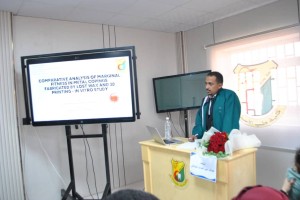
Ms. Razan Mohammed Nader Ali Jarada was awarded a Master’s Degree in Orthodontics for her thesis titled: Evaluation of Condyle and Glenoid Fossa Position in Different Sagittal Skeletal Patterns: A Cone-Beam Computed Tomography Study, which was submitted to the Department of Orthodontics, Faculty of Dentistry – Sana’a University. The MA defense was held on Thursday, April 16, 2026.
The MA Viva-voce Committee, which was formed based on a resolution issued by the Graduate Studies and Scientific Research Council, consisted of the following:
| # | Committee Members | Designation | Position |
| 1 | Prof. Yasser Ali Thabet | External Examiner | Chair |
| 2 | Prof. Khaled Abdul Salam Al-Haddad | Main Supervisor | Member |
| 3 | Prof. Fouad Lutfi Al-Mutarrib | Internal Examiner | Member |
The thesis aimed to:
- Evaluate the position of the mandibular condyle and the glenoid fossa across different sagittal skeletal patterns using cone-beam computed tomography (CBCT).
- Analyze anatomical relationships and morphological differences between the condyle and glenoid fossa across skeletal patterns.
- Examine the effect of gender on condylar position and dimensions within each skeletal pattern.
- Assess the degree of symmetry between the right and left temporomandibular joints.
The study yielded several key findings summarized as follows:
- There were statistically significant differences in craniofacial and skeletal measurements among different skeletal patterns, despite balanced vertical facial dimensions.
- Central positioning of the condyle was a common feature across all skeletal patterns.
- Class III malocclusion was associated with a narrower and thinner glenoid fossa compared to other patterns.
- The articular eminence inclination was more pronounced in Class II cases.
- Gender-related differences were observed, with males exhibiting larger condylar dimensions.
- Although general symmetry between the two sides was observed, some variables showed significant differences, indicating slight asymmetry between the right and left joints.
In light of these findings, the researcher recommended the following:
- Conducting further research on larger samples and longitudinal studies to validate the continuity of findings.
- Expanding research on severe malocclusion cases.
- Improving classification of crossbite and data collection methodologies, with emphasis on prospective studies.
- Adopting a more comprehensive classification of vertical facial proportions.
- Classifying samples according to age groups to enable more precise comparisons.
- Performing dynamic evaluation of the temporomandibular joint to overcome the limitations of static analysis.
- Investigating soft tissues using magnetic resonance imaging (MRI) for a more comprehensive assessment.
The defense session was attended by a number of academics, researchers, students, colleagues, and the researcher’s family.