Master’s Degree Awarded to Mr. Nayef Al-Araiqi in Oral and Maxillofacial Surgery

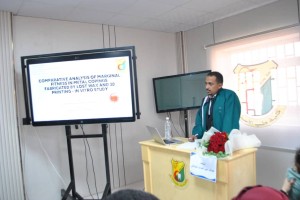
Mr. Nayef Rashid Abdulrab Ali Al-Araiqi was awarded a Master’s Degree in Oral and Maxillofacial Surgery for his thesis titled: Evaluation of the Accuracy of CAD/CAM Occlusal Wafers in Orthognathic Surgery in a Sample of Yemeni Patients, which was submitted to the Department of Oral and Maxillofacial Surgery, Faculty of Dentistry– Sana’a University. The MA defense was held on Tuesday, April 21, 2026.
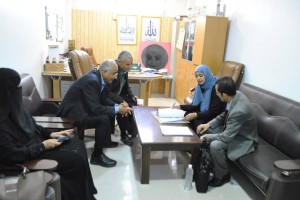
The MA Viva-voce Committee, which was formed based on a resolution issued by the Graduate Studies and Scientific Research Council, consisted of the following:
| # | Committee Members | Designation | Position |
| 1 | Assoc. Prof. Akram Thabet Nasher | Internal Examiner | Chair |
| 2 | Prof. Abdullah Hassan Thabet Farhan | Main Supervisor | Member |
| 3 | Asst. Prof. Ahmed Saleh Yahya Al-Khatri | External Examiner | Member |
The thesis aimed to:
- Evaluate the accuracy of CAD/CAM-generated occlusal splints in orthognathic surgery by comparing virtually planned surgical outcomes with actual postoperative results using two-dimensional cephalometric radiographs.
The study adopted a prospective comparative clinical approach conducted on a sample of nine Yemeni patients (eight females and one male) with skeletal discrepancies requiring orthognathic surgery. Preoperative planning included clinical examination and two-dimensional cephalometric analysis based on Steiner analysis. Three-dimensional virtual surgical planning was performed using Dolphin software based on CT imaging data and digital dental models. Intermediate and final occlusal splints were fabricated using 3D printing technology. The same surgical team performed all surgical procedures. Outcomes were evaluated one month postoperatively by comparing 19 cephalometric variables using SPSS statistical analysis.
The study yielded several key findings summarized as follows:
- There were no statistically significant differences between virtually planned measurements and postoperative outcomes across all skeletal, dental, and soft tissue variables.
- Observed differences remained within clinically acceptable limits (2 mm and 2 degrees).
- High accuracy was achieved in transferring planned surgical movements, with effective repositioning of the jaws.
- The study concluded that CAD/CAM-generated occlusal splints represent an accurate and reliable method for translating virtual surgical planning into actual clinical outcomes in orthognathic surgery.
In light of these findings, the researcher recommended the following:
- The routine use of CAD/CAM occlusal splints due to their effectiveness in enhancing surgical accuracy and predictability of outcomes.
The defense session was attended by a number of academics, researchers, students, colleagues, and the researcher’s family.