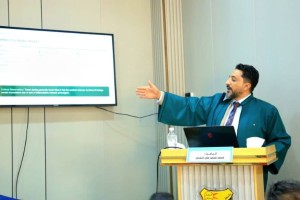
Master’s Degree Awarded to Mr. Akram Ameen in Orthodontics

Mr. Akram Mohammed Ahmed Ameen was awarded a Master’s Degree in Orthodontics for his thesis titled: Validation of the Arc Analysis in the Skeletal Evaluation of Lateral Cephalometric Descriptions among a Sample of Yemeni Adults, which was submitted to the Department Orthodontics, Faculty of Dentistry – Sana’a University. The MA defense was held on Wednesday, May 6, 2026.
The MA Viva-voce Committee, which was formed based on a resolution issued by the Graduate Studies and Scientific Research Council, consisted of the following:
| # | Committee Members | Designation | Position |
| 1 | Prof. Ghamdan Abdullah Al-Harazi | Internal Examiner | Chair |
| 2 | Prof. Hussein Mohammed Shujaa Al-Deen | Main Supervisor | Member |
| 3 | Prof. Khaled Ahmed Ali Al-Dhura’i | External Examiner | Member |
The thesis aimed to:
- Validate Sassouni’s Arc Analysis in comparison with Steiner’s quantitative analysis in the skeletal evaluation of lateral cephalometric measurements among a group of Yemeni adults, using lateral radiographic assessment as the gold standard for evaluation.
- Assess the accuracy of Arc Analysis in describing vertical and anteroposterior skeletal relationships.
- Evaluate Arc Analysis’ ability to provide individualized diagnosis based on facial proportionality rather than relying on fixed numerical reference values commonly used in traditional analyses.
The study yielded several key findings summarized as follows:
- Arc Analysis demonstrated superiority in providing a detailed and individualized diagnostic perspective for each patient, as it is based on facial proportionality rather than fixed reference measurements.
- Arc Analysis was more effective in identifying most vertical relationships compared with Steiner Analysis, whereas Steiner Analysis showed greater accuracy in diagnosing Class II malocclusion in relation to anteroposterior relationships compared with Sassouni Analysis.
- The findings confirmed the importance of Arc Analysis as a modern diagnostic tool that contributes to more accurate assessments aligned with the patient’s true facial aesthetics, thereby improving orthodontic treatment planning.
In light of these findings, the researcher recommended the following:
- Using Sassouni Analysis as a primary diagnostic tool for evaluating skeletal proportionality due to its high capability in providing accurate individualized diagnoses that correspond with the patient’s true facial aesthetics, rather than relying solely on numerical values, in order to preserve facial skeletal harmony in treatment planning.
- Conducting similar longitudinal studies on age groups younger than 14 years to assess the effectiveness of Arc Analysis in predicting growth patterns.
- Utilizing digital analysis software to increase measurement accuracy and improve diagnostic evaluation efficiency.
The defense session was attended by a number of academics, researchers, students, colleagues, and the researcher’s family.