Sana’a – Monday, May 4, 2026
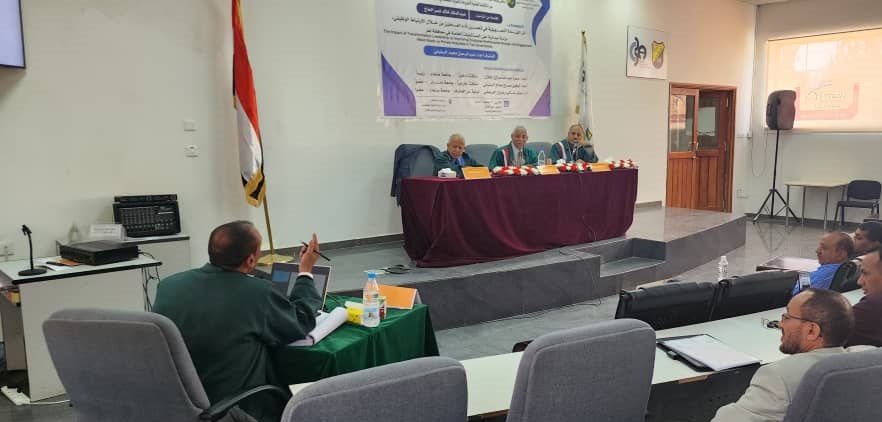
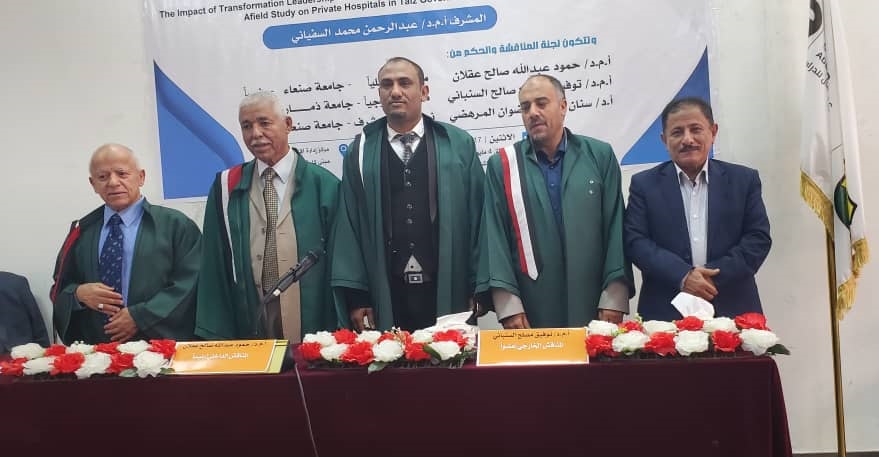
Researcher Abdulmalik Khaled Nasr Al-Hajj was awarded a PhD degree in Business Administration by the Center of Business Administration for Graduate Studies at Sana’a University for his dissertation titled: “The Impact of Transformational Leadership on Improving Employee Performance Through Work Engagement: A Field Study of Private Hospitals in Taiz Governorate.” The dissertation was supervised by Assoc. Prof. Dr. Abdulrahman Mohammed Ahmed Al-Sufyani.
The PhD Viva-Voce Committee consisted of Assoc. Prof. Dr. Hamoud Abdullah Saleh Aqlan, Sana’a University, as Internal Examiner and Chair; Assoc. Prof. Dr. Tawfiq Musleh Saleh Al-Sanbani, Dhamar University, as External Examiner and Member; and Prof. Dr. Sinan Ghaleb Al-Marhadi, Sana’a University, representing the Supervisor and serving as a Member.
The dissertation defense was attended by a number of academics, researchers, postgraduate students, and other interested individuals, in addition to the researcher’s colleagues and family members.
The study aimed to assess the current level of transformational leadership practices in private hospitals in Taiz Governorate, as well as the levels of employee performance improvement and work engagement among employees in the hospitals under study. It also examined the effects of transformational leadership, both collectively and individually through its dimensions of idealized influence, inspirational motivation, intellectual stimulation, and individualized consideration, on employee performance and work engagement. Furthermore, the study investigated the effect of work engagement on employee performance and examined the effect of transformational leadership on employee performance through work engagement as a mediating variable.
The study population consisted of 708 employees, including administrators, physicians, and technical staff working across 13 private hospitals in Taiz Governorate. A stratified random sample of 249 respondents was selected, of which 228 valid questionnaires were used for statistical analysis. The study adopted a descriptive approach, and the data were analyzed using the Statistical Package for the Social Sciences (SPSS) and AMOS.
The study reached several findings, most notably that the levels of transformational leadership practices, employee performance improvement, and work engagement in the hospitals under study were all high.
The findings also showed a statistically significant effect of transformational leadership, as a composite construct, on employee performance. At the dimensional level, inspirational motivation and intellectual stimulation had positive effects on employee performance, whereas idealized influence and individualized consideration did not have statistically significant effects.
Furthermore, transformational leadership as a composite construct had a statistically significant effect on work engagement. Intellectual stimulation, inspirational motivation, and individualized consideration had positive effects on work engagement, while idealized influence did not have a significant effect.
The findings also demonstrated a statistically significant effect of work engagement on employee performance. Among its dimensions, dedication and absorption had positive effects on employee performance, whereas vigor did not have a statistically significant effect. In addition, the study confirmed a statistically significant effect of transformational leadership on employee performance through work engagement as a mediating variable in private hospitals in Taiz Governorate.
The study recommended strengthening the transformational leadership approach in private hospitals in Taiz Governorate due to its positive contribution to enhancing employee work engagement. It also recommended strengthening the role of work engagement, particularly dedication and absorption, as they have a direct influence on employee performance. Enhancing these aspects would contribute to improving employee performance and strengthening hospitals’ ability to respond effectively to competitive challenges and environmental and epidemiological changes.