Master’s Degree Awarded to Ms. Shamiah Mohammed Musleh in Tafsir and Quranic Studies
- Categories Letters and Promotions - Graduate Studies, news, Regulations - Postgraduate Studies
- Date August 25, 2025
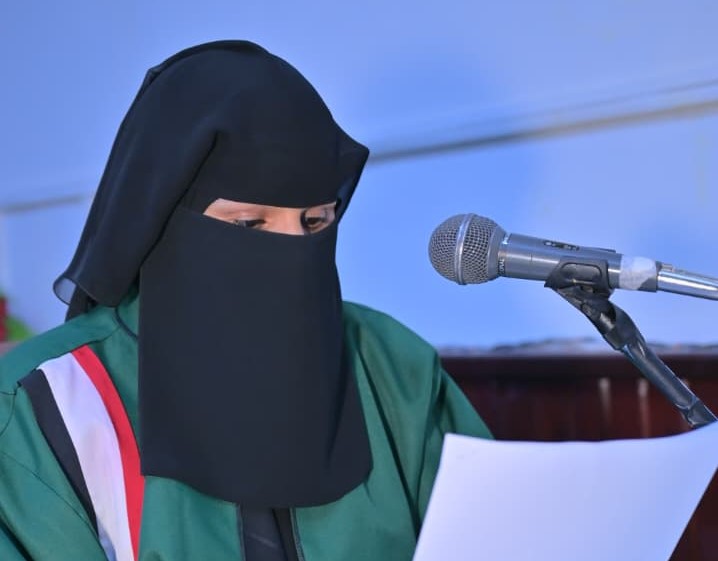
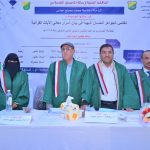
Ms. Shamiah Mohammed Musleh was awarded a Master’s degree in Tafsir and Quranic Studies with an average of (Excellent) and a grade of (95%) for her thesis titled: Nafaes Al-Jawaher Al-Hesan Al-Bahia in Explaining the Secrets of the Meanings of Quranic Verses by the Scholar Al-Hasan bin Ibrahim Al-Khatib Al-Zubaidi Al-Yamani (d. 1265 Hijri): A Critical Study and Investigation of Surat Hud, which was submitted to the department of Quran and Its Sciences, Faculty of Education – Sana’a University. The MA defense was held on Tuesday, August 19, 2025).
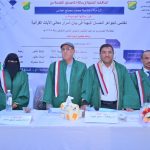
The MA Viva-voce Committee, which was formed based on a resolution issued by the Graduate Studies and Scientific Research Council, consisted of the following:
| # | Committee Members | Designation | University | Position |
| 1 | Prof. Rifaat Hussein Aburah | Internal Examiner | Sana’a University | Chair |
| 2 | Prof. Abdu Mohammed Yusuf | Main Supervisor | Sana’a University | Member |
| 3 | Assoc. Prof. Mohammed Shouqi Nasser | External Examiner | Hajjah University | Member |
The Study set out to achieve several significant objectives as follows:
- To introduce the eminent Yemeni scholar Al-Hasan bin Ibrahim Al-Khatib Al-Zubaidi (d. 1265 Hijri) and highlight his contributions to Quranic exegesis.
- To present an overview of his exegesis, Nafaes Al-Jawaher Al-Hesan Al-Bahia in Explaining the Secrets of the Meanings of Quranic Verses, explaining its importance and unique features.
- To examine the author’s methodology, sources, scholarly opinions, and interpretation preferences.
- To produce a verified critical edition of Surat Hud based on modern academic principles for manuscript authentication.
The Study yielded several key findings as follows:
- The study confirmed the authenticity of such an exegesis and attributed it to its author. It highlighted that the scholar was among Yemen’s leading 13th-century Hijri scholars, renowned for his scholarly stature and diverse expertise, particularly in Quranic exegesis and linguistics.
The Study concluded with the following recommendations:
- Completing and publishing the remaining parts of such an exegesis in an academically verified form.
- Encouraging researchers to document, classify, and critically edit Yemeni manuscripts for public benefit.
- Incorporate the science of manuscript authentication as a core component in postgraduate curricula within faculties of Sharia and Islamic Studies.
The defense session was attended by a number of academics, researchers, colleagues, and the researcher’s family members.
The Study yielded several key findings as follows:
- The adoption of digital forensic accounting in Yemen is currently at a moderate level, with significant potential for enhancement, particularly through improved funding, training, and regulatory structures.
- Strategic collaboration between institutions and government entities is a key success factor in fostering adoption.
The researcher proposed several recommendations, including:
- Implementing digital forensic accounting tools (e.g., FTK) and integrating them with financial accounting and auditing systems.
- Improving the technical infrastructure, with particular focus on network capacity and cybersecurity systems.
- Developing a specialized technical workforce with expertise in digital forensic accounting.
- Promoting a culture of digital evidence utilization through interactive training workshops and internal awareness campaigns.
- Updating the legal framework by enacting clear and enforceable legislation supporting digital forensic practices.
The thesis defense was attended by several academics, researchers, students, and interested professionals, along with the researcher’s colleagues and family members.
Discover more from Sana'a University
Subscribe to get the latest posts sent to your email.

Previous post
Master’s Degree Awarded to Mr. Adel Saleh Mohammed in Curricula and Methods of Teaching English
Next post