Master’s Degree Awarded to Ms. Fatima Abdullah Mutahhar in Qur’anic Exegesis
- Categories Letters and Promotions - Graduate Studies, news, Regulations - Postgraduate Studies
- Date January 8, 2026

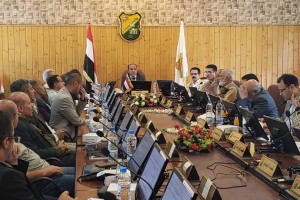
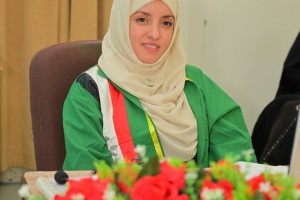
Ms. Fatima Abdullah Mutahhar Al-Qasemi was awarded a Master’s Degree in Qur’anic Exegesis with an average of Excellent and a grade of (95) for her thesis titled: Al-Jawhar Al-Shafaf Al-Multaqat min Maghasat Al-Kashaf, which was submitted to the Department of Islamic Studies, Faculty of Arts and Humanities – Sana’a University. The MA defense was held on Tuesday, December 23, 2025.
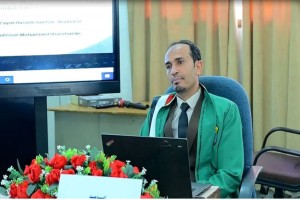
The MA Viva-voce Committee, which was formed based on a resolution issued by the Graduate Studies and Scientific Research Council, consisted of the following:
# Committee Members Designation Position
1 Assoc. Prof. Ibrahim Abdullah Jaber External Examiner Chair
2 Dr. Iman Abdullah Hussein Hajer Main Supervisor Member
3 Dr. Hassan Ali Abduljabbar Al-Seruri Internal Examiner Member
The study aimed to:
Introduce Imam Abdullah ibn Al-Hadi.
Bring to light the manuscript Al-Jawhar Al-Shafaf and enrich the Islamic library with this valuable exegetical work.
Highlight the scholarly, intellectual, and jurisprudential views contained in the work, drawing on the contributions of the Imams of Ahl Al-Bayt (peace be upon them) and the Imams of the four Sunni schools of jurisprudence.
The study yielded a number of key findings summarized as follows:
Imam Abdullah ibn Al-Hadi possessed vast knowledge, demonstrated deep mastery of multiple disciplines, and excelled in Qur’anic exegesis, marked by precision and depth of thought; his family’s scholarly legacy significantly influenced his devotion to learning.
The commonly cited date of death for Imam Abdullah ibn Al-Hadi required correction; the research established that he died after 850 AH, not in 793 AH as previously reported by biographers.
The era of Imam Abdullah ibn Al-Hadi represented a flourishing period in Yemen’s intellectual history, as the Imams and the Rasulids supported scientific and scholarly activity despite prevailing political instability.
The author of Al-Jawhar Al-Shafaf crafted his commentary as a concise encyclopedic work.
Al-Jawhar Al-Shafaf ranked among the finest works engaging with “Al-Kashaf” in terms of clarity, facilitation, and the valuable additions that enhanced its utility for scholars of Qur’anic exegesis.
In light of these findings, the researcher recommended:
Editing and verifying unedited valuable manuscripts that contain significant scholarly treasures.
Publishing verified manuscripts that remain unpublished, including Al-Jawhar Al-Shafaf Al-Multaqat min Maghasat Al-Kashshaf, after completing the study and verification of its remaining parts, given its status as one of the most important and accessible commentaries on Al-Kashaf.
Re-editing and republishing heritage works previously printed without rigorous scholarly verification, across various fields, following sound academic standards.
The defense session was attended by a number of academics, researchers, students, colleagues, and the researcher’s family.


Discover more from Sana'a University
Subscribe to get the latest posts sent to your email.

Previous post
PhD Degree Awarded to Mr. Ammar Al-Sharafi in International Development and Gender Studies
Next post