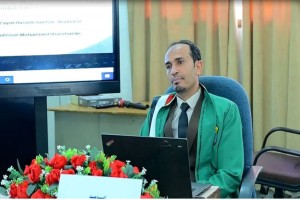
PhD Degree Awarded to Mr. Hisham Ahmed Al-Faqih in Cardiovascular Medicine
- Categories Letters and Promotions - Graduate Studies, news, Regulations - Postgraduate Studies
- Date January 17, 2026

Mr. Hisham Ahmed Al-Haj Al-Faqih was awarded a PhD degree in the major of Cardiovascular Medicine for his dissertation titled, “Relationship Between C-Reactive Protein-to-Albumin Ratio and Coronary Artery Calcium Score and CAD-RADS Scores with Coronary Computed Tomography Angiography Among Yemeni Patients,” which was submitted to the Department of Cardiovascular, Faculty of Medicine and Health Sciences – Sana’a University. The PhD dissertation defense was held on Thursday, January 15, 2026.
The PhD Viva-Voce Committee, which was formed based on a resolution issued by the Post-Graduate Studies and Scientific Research Council, consisted of the following members:
# Committee Members Designation University Position
1 Prof. Ahmed Lutf Al-Motareb Internal examiner Sana’a University Chair
2 Prof. Mohammed Ali Hussein Al-Houthi External Examiner Thamar University Member
3 Prof. Abdulnaser Ali Munaibari Main supervisor Sana’a University Member
This study aims to evaluate the predictive value of the C-reactive protein-to-albumin ratio (CAR) as a clinical inflammatory biomarker. By correlating CAR levels with Coronary Artery Calcium Scores (CACS) and stenosis severity—classified under the Coronary Artery Disease-Reporting and Data System (CAD-RADS)—the research seeks to enhance early diagnostic tools within the Yemeni healthcare environment.
The study presented several significant clinical findings, including:
1- There was a statistically significant positive correlation between CAR levels, coronary calcium scores (CACS), and CAD-RADS classifications.
2- Significantly higher CAR values were observed in patients with confirmed coronary artery disease compared to healthy subjects.
3- High CAR levels increased in tandem with the severity of stenosis and calcification seen on CCTA, proving CAR to be a robust independent predictor of clinically significant arterial narrowing.
4- The study confirmed that CAR serves as a low-cost, accessible, and reliable biomarker for clinical diagnosis.
The study put forth the following recommendations:
1- Integrating CAR measurement into routine diagnostic protocols for coronary risk assessment.
2- Combining biomarker data with CCTA results to improve predictive accuracy and guide personalized treatment plans.
3- Adopting the Coronary Calcium Score as a standard preventive screening tool for high-risk populations.
4- Conducting large-scale longitudinal studies to establish national diagnostic benchmarks for early intervention.
The PhD dissertation was examined and recommended by the Viva-Voce Committee for acceptance and approval. The PhD defense was attended by a number of academics, researchers, interested students, the candidate’s colleagues, and family members.


Discover more from Sana'a University
Subscribe to get the latest posts sent to your email.

Previous post