PhD Degree Awarded to Mr. Mohammed Mohammed Al-Soudi in Islamic Studies
- Categories Letters and Promotions - Graduate Studies, news, Regulations - Postgraduate Studies
- Date February 12, 2026

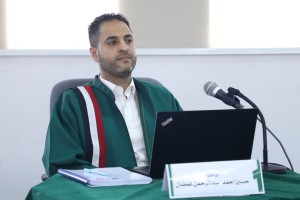
Mr. Mohammed Mohammed Mahdi Al-Soudi was awarded a PhD degree in Islamic Studies for his dissertation titled: Ihsan and Its Relationship to Sharia Objectives: An Applied Study, which was submitted to the Department of Islamic Studies, Faculty of Arts and Humanities – Sana’a University. The dissertation defense was held on Thursday, February 5, 2026.
The PhD Viva-Voce Committee, which was formed based on a resolution issued by the Graduate Studies and Scientific Research Council, consisted of the following:
# Committee Members Designation Position
1 Prof. Kawthar Hamoud Mohammed Al-Mekhlafi Internal Examiner Chair
2 Assoc. Prof. Adel Saleh Ali Al-Faqih Main Supervisor Member
3 Assoc. Prof. Taha Monassar Ahmed Al-Aqbi External Examiner Member
The dissertation aimed to:
Examine the concept of ihsan (excellence or benevolence), a term clear in both its wording and meaning, considered the highest rank of faith, its essence, and its perfection.
Highlight the comprehensiveness of ihsan and its connection to all aspects of life, linking it to the higher objectives of Islamic law (Maqasid al-Sharia) and emphasizing acting in accordance with those objectives.
The significance of the dissertation lies in the central status that the science of Sharia Objectives occupies among Islamic sciences.
The research employed a descriptive, analytical, and historical methodology, examining relevant textual sources, including Qur’anic exegesis, Prophetic traditions, and other related scholarly works.
The study yielded several key findings summarized as follows:
Ihsan encompasses all human relationships—whether with one’s Lord, oneself, or others.
Linguistically, ihsan denotes bestowing goodness upon oneself and others until one’s condition becomes sound and virtuous.
In its technical sense, ihsan relates to the person’s relationship with Allah, manifested through constant awareness of divine supervision, fulfilling commands, avoiding prohibitions, and acting with sincere intention in alignment with the objectives of Sharia.
The dissertation emphasized that ihsan plays a vital role in achieving the objectives of Islamic law. A strong interrelationship exists between Sharia and its objectives and between ihsan and its purposes. Both converge in safeguarding the five essential universal values: religion, life, intellect, honor, and property—core objectives firmly established within Maqasid theory.
The study further demonstrated that:
Every noble moral quality encouraged by Sharia, every act that realizes benefit for others, and every kind word spoken to people falls within the domain of ihsan.
Ihsan strengthens social cohesion, protects society from corruption and destruction, and guards it against social ills.
Practicing ihsan serves as a true sign of one’s sound faith and represents the measure of success in life, which is fundamentally a test.
Those who practice ihsan gain divine companionship and love; when Allah loves a person, He makes that person beloved among people.
The doers of ihsan will receive immense reward in the Hereafter, including security from fear and grief, empowerment on earth, and nearness to divine mercy.
While justice preserves human existence, ihsan elevates and advances society by strengthening bonds and fostering cooperation.
Ihsan removes resentment, misunderstanding, and negative suspicion from hearts.
Core Conclusions
The research centered on two fundamental principles:
1. Ihsan contributes to preserving religion, life, intellect, honor, and wealth, both in terms of their protection and continuity, at the levels of the individual, society, and the state.
2. The study adopted an inductive, historical, analytical, jurisprudential, and Maqasid-based methodology to analyze the subject matter.
From these foundations, the study derived several subsidiary conclusions, including:
Supporting religion constitutes a form of ihsan, as reflected in the Qur’anic verse: “O believers! If you stand up for Allah, He will help you and make your steps firm” (Qur’an 47:7).
Excellence in worship expiates past sins, and such expiation continues as long as ihsan persists.
Ihsan entails safeguarding human dignity in both this world and the Hereafter, protecting individuals from physical and psychological harm, upholding justice, and eliminating oppression.
Ihsan represents one of the fundamental values commanded by Allah: “Indeed, Allah commands justice, grace, as well as generosity to close relatives. He forbids indecency, wickedness, and aggression.” (Qur’an 16:90).
The dissertation defense was attended by a number of academics, researchers, and specialists, students, colleagues, and the researcher’s family.


https://youtube.com/shorts/GryCVvsDCJw?feature=share
Discover more from Sana'a University
Subscribe to get the latest posts sent to your email.

Previous post
Master’s Degree Awarded to Ms. Samah Rashad Abdullah Al-Akhali in Neuropsychology
Next post