Master’s Degree Awarded to Ms. Afnan Ali An-Nahari in Translation
- Categories Letters and Promotions - Graduate Studies, news, Regulations - Academic Affairs
- Date February 14, 2026

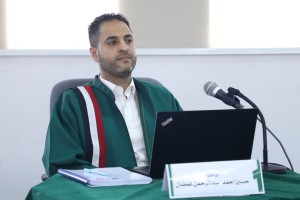
Ms. Afnan Ali Mohammed Ahmed An-Nahari was awarded a Master’s Degree in Translation with an average of Excellent and a grade of (95) for her thesis titled: Cultural Manipulation of Children’s Literature Dubbing from English into Arabic: A Translation Quality Assessment of Extralinguistic Cultural References in The Simpsons, which was submitted to the Community Center for Translation and Language Teaching (CCTLT) – Sana’a University. The MA defense was held on Thursday, February 5, 2026.
The MA Viva-voce Committee, which was formed based on a resolution issued by the Graduate Studies and Scientific Research Council, consisted of the following:
# Committee Members Designation Position
1 Prof. Abdulhameed A. Ashuja’a Internal Examiner Chair
2 Prof. Ibraheem Tagaddeen Main Supervisor Member
3 Prof. Mohammed Qasim Al-Sharmani External Examiner Member
The thesis aimed to:
Explore the main themes, ideological underpinnings, and extralinguistic cultural references embedded in selected examples from The Simpsons, using Critical Discourse Analysis.
Investigate the problems of translating extralinguistic cultural references in the children’s series The Simpsons from English into Arabic.
Identify the strategies used in the dubbed Arabic version of The Simpsons, based on Pedersen’s (2011) taxonomy of ECR transfer strategies.
Assess the translation quality of the dubbed children’s series The Simpsons from English into Arabic in light of Pedersen’s (2017) FAR model of quality assessment.
The study yielded a number of key findings summarized as follows:
The primary difficulty in translating extralinguistic cultural references lies in rendering meaning heavily embedded in Western culture for a Muslim Arab child audience.
The translation tends to rely on substituting Western cultural references with elements more compatible with Arab children’s culture.
These challenges are partly attributable to insufficient oversight by regulatory bodies and translation institutions in evaluating content targeting Arab children, as well as a lack of scholarly research on children’s literature translation.
In light of these findings, the researcher recommended the following:
Giving greater attention to assessing the quality of translating cultural references in content directed at Muslim Arab children.
Strengthening collaboration among translators, educational specialists, and reviewers within cartoon production institutions to ensure culturally and pedagogically appropriate dubbed versions.
Establishing clear criteria for evaluating the quality of translating cultural references in animated works, with due consideration for cultural suitability and semantic accuracy.
Encouraging further research on the impact of translators’ cultural choices on shaping the ideology of Muslim Arab children across various animated series.
The defense session was attended by a number of professors, researchers, students, colleagues, and the researcher’s family.


Discover more from Sana'a University
Subscribe to get the latest posts sent to your email.

Next post