Sana’a University Affirms Readiness to Localize Scientific Research and Link It to Industry and State Institutions
Sana’a – 16 February 2026 (28 Sha‘ban 1447 AH)
Sana’a University has affirmed its full readiness to direct scientific research toward serving national development priorities and strengthening its direct linkage with the industrial sector and state institutions.
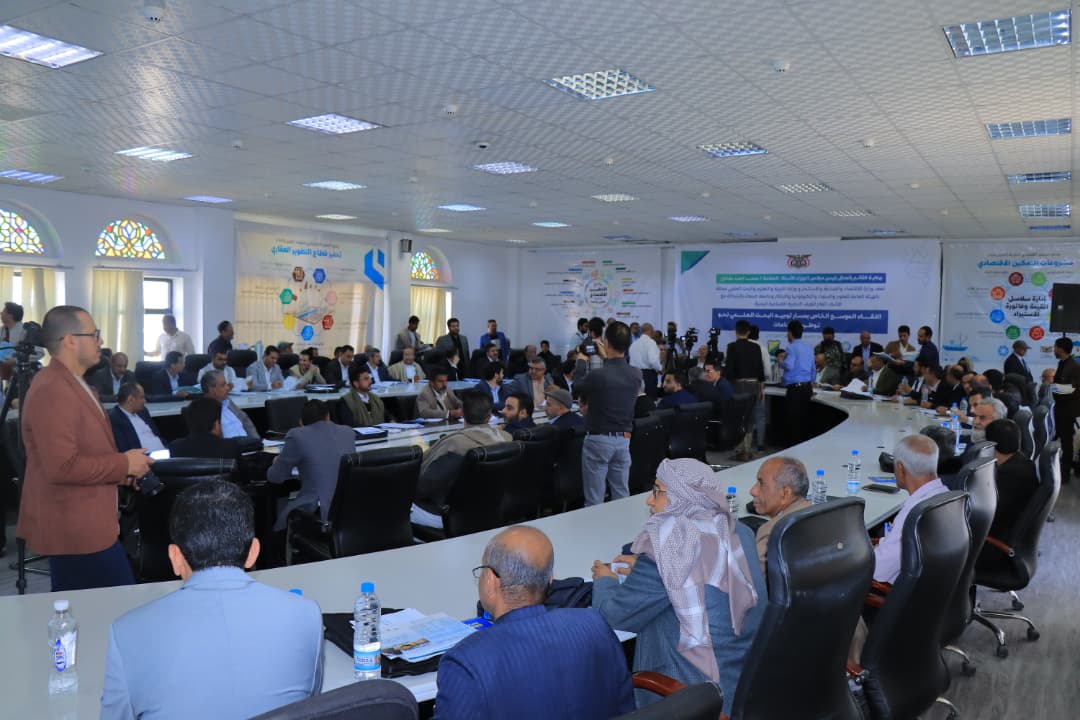
This came during the University’s participation in an expanded meeting on steering scientific research toward industrial localization. The event was organized by the Ministry of Economy, Industry and Investment in cooperation with the Ministry of Education and Scientific Research, represented by the General Authority for Science, Research, Technology and Innovation, and in partnership with the General Federation of Chambers of Commerce and Industry. The meeting brought together senior government and academic leaders, as well as representatives of the private sector.
During the session, Minister of Education and Scientific Research Hasan Al-Saadi emphasized the importance of developing an executive matrix to translate the meeting’s recommendations into practical programs, highlighting the need to invest in national research capacities to address development challenges. Acting Minister of Economy, Industry and Investment Sam Al-Basheeri described industrial localization as a strategic option to strengthen domestic production and reduce reliance on imports, underscoring the importance of building effective partnerships between universities and factories.
In his address, Rector of Sana’a University, Prof. Mohammed Al-Bukhaiti, stated that the University is moving steadily toward advancing its academic and research systems and aligning its outputs with the needs of state institutions and the labor market. He stressed that national progress can only be achieved through the integration of education, scientific research, and community service, calling for a structured institutional partnership between the University, executive authorities, and the private sector.
He further noted that the University has witnessed significant qualitative development in recent years, introducing new colleges and specialized programs, including Chemical Engineering, Applied Bioengineering, and Mechatronics Engineering, in addition to expanding medical, agricultural, environmental, and humanities disciplines. This expansion has been accompanied by updated curricula and continuous efforts to enhance the quality of academic outcomes.
With regard to postgraduate studies, Prof. Al-Bukhaiti explained that the University currently offers 234 Master’s and PhD programs—up from fewer than 20 programs prior to 2015—with approximately 6,000 postgraduate students enrolled. He reaffirmed the University’s commitment to safeguarding the quality and academic value of its degrees.
In the field of research, he revealed that the University published approximately 520 peer-reviewed scientific papers in reputable journals in 2025, reflecting the dynamic research activity and scientific capabilities available. These outputs, he noted, position the University to provide applicable solutions that support industrial localization and help bridge gaps within the value-added production chain.
During the accompanying workshop, Deputy Minister of Economy for Policies, Studies, and Planning Mr. Fuad Al-Junaid presented the comprehensive national framework for industrial localization in Yemen. Meanwhile, the Chairman of the General Authority for Science, Research, Technology and Innovation, Dr. Muneer Al-Qadi, delivered a working paper on coordination mechanisms between educational and research institutions and industrial sectors. The Head of the Scientific Committee at Sana’a University, Dr. Taha Al-Washli, highlighted the importance of directing applied research toward industrial development requirements and strengthening partnerships with factories.
The University Rector also presented the project titled “The Role of Sana’a University in Community Service and Consultancy,” which aims to provide high-quality, cost-effective studies and scientific expertise to state institutions. He called for reinforcing institutional linkages between official entities and the University, as well as opening factories and production lines to students for practical training to bridge the gap between theoretical knowledge and practical application.
The meeting, attended by Prof. Zaid Al-Wareeth, Rector’s Assistant for Scientific and Research Centers Affairs, along with officials from relevant entities, concluded with a set of recommendations aimed at strengthening integration between scientific research and the industrial sector. Sana’a University reaffirmed its continued commitment to its national role as a scientific and knowledge-driven institution and a leading force in localizing research, industry, and community service.


Discover more from Sana'a University
Subscribe to get the latest posts sent to your email.