Master’s Degree Awarded to Ms. Sawsan Mohammed Al-Sharasi in Computer Science
- Categories Letters and Promotions - Graduate Studies, news, Regulations - Postgraduate Studies
- Date February 23, 2026
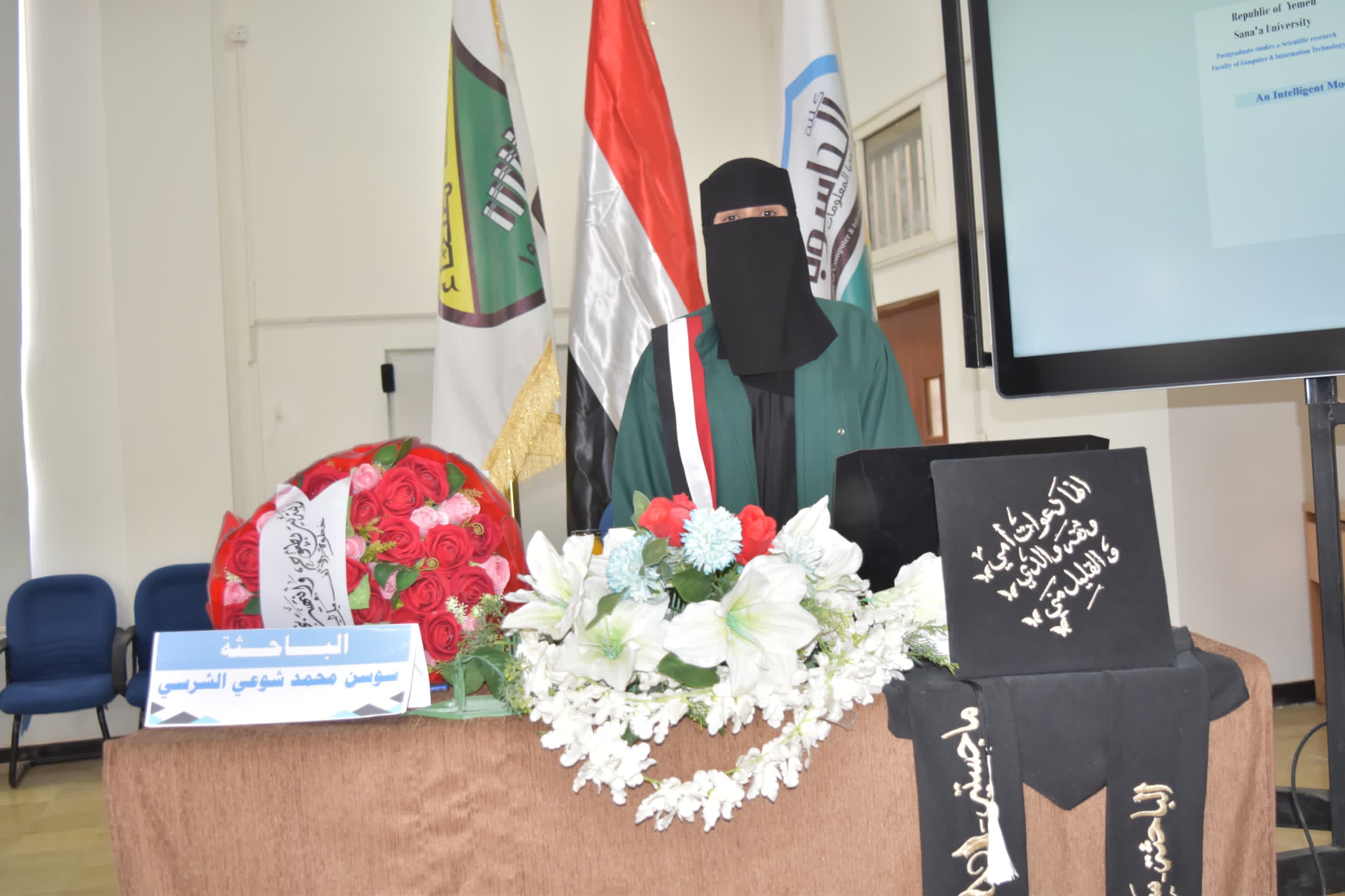
Ms. Sawsan Mohammed Shoaib Ali Al-Sharasi was awarded a Master’s Degree in Computer Science with an average of Excellent and a grade of (95) for her thesis titled: An Intelligent Model for Early Prediction of Polycystic Ovary Syndrome, which was submitted to the Department of Computer Science, Faculty of Computer and Information Technology – Sana’a University. The MA defense was held on Tuesday, February 17, 2026.
The MA Viva-voce Committee, which was formed based on a resolution issued by the Graduate Studies and Scientific Research Council, consisted of the following:
# Committee Members Designation Position
1 Prof. Malek Nasser Al-Jabri Internal Examiner Chair
2 Prof. Ghaleb Hamoud Al-Jaafari Main Supervisor Member
3 Associate Prof. Ayed Abdulaziz Mohsen External Examiner Member
The thesis aimed to:
• Develop a robust and intelligent diagnostic model based on artificial intelligence and bioinformatics techniques, combining deep learning and machine learning to diagnose Polycystic Ovary Syndrome (PCOS) in its early stages. The model analyzes ultrasound images alongside patients’ clinical data.
The study focused on improving diagnostic accuracy and reducing reliance on human expertise, particularly in resource-limited settings.
The study yielded several key findings summarized as follows:
• The use of Stacking Ensemble learning models in analyzing clinical data, along with an object detection model for ultrasound image analysis, achieved high predictive accuracy, improved sensitivity, and reduced missed cases.
• Addressing data imbalance and selecting the most influential features played a crucial role in enhancing model efficiency and generalization capability.
• The study emphasized the importance of Explainable AI (XAI). Using SHAP analysis, the model was able to clarify the contribution of each clinical variable to the final decision, thereby increasing medical trust in the system’s outputs and positioning it as a transparent decision-support tool rather than a “black box.”
In light of these findings, the researcher recommended the following:
• Adopting AI-based clinical decision support systems in healthcare institutions and gradually integrating them with electronic medical record systems.
• Developing APIs to connect intelligent models with hospital systems without requiring major changes to existing technical infrastructure.
• Expanding local medical databases through enhanced collaboration between hospitals and radiology centers to improve model performance and generalizability.
• Establishing continuous training programs for physicians and technicians on using AI systems as decision-support tools rather than substitutes for clinical evaluation.
• Supporting multi-center research and broader clinical trials to ensure readiness for practical implementation.
The thesis concluded that integrating medical expertise with intelligent technologies represents a strategic step toward developing a more accurate and efficient diagnostic system, contributing to improved healthcare quality, reduced human error, and faster medical decision-making.
The defense session was attended by academics, researchers, students, interested individuals, colleagues, and the researcher’s family.


Discover more from Sana'a University
Subscribe to get the latest posts sent to your email.

You may also like
Master’s Degree Awarded to Ms. Marsala Hajar in Orthodontics
Master’s Degree Awarded to Ms. Amat Al-Salam Al-Makhethi in Orthodontics