
Master’s Degree Awarded to Ms. Marsala Hajar in Orthodontics
- Categories Letters and Promotions - Graduate Studies, news, Regulations - Postgraduate Studies
- Date February 24, 2026
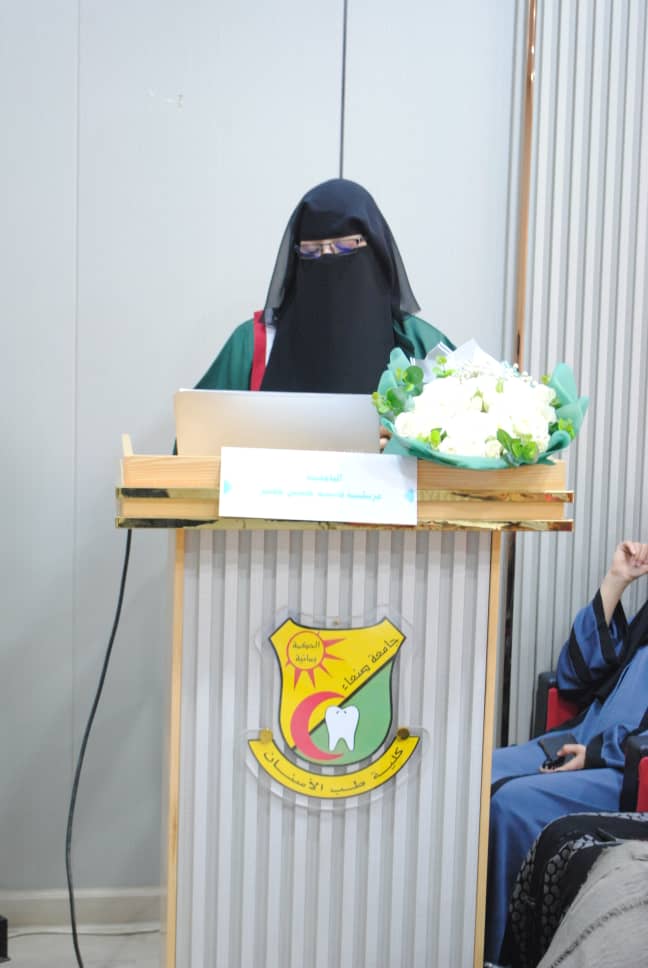
Ms. Marsala Qasem Hassan Hajar was awarded a Master’s Degree in Orthodontics for her thesis titled: Canine Retraction Using NITI Closed Coil Spring Vs. Memory Rastomerie Chain: A Split-Mouth Clinical Trial, which was submitted to the Department of Orthodontics, Faculty of Dentistry – Sana’a University. The MA defense was held on Thursday, February 12, 2026.
The MA Viva-voce Committee, which was formed based on a resolution issued by the Graduate Studies and Scientific Research Council, consisted of the following:
# Committee Members Designation Position
1 Prof. Ghamdan Abdullah Al-Harazi Internal Examiner Chair
2 Prof. Khaled Abdulsalam Al-Haddad Main Supervisor Member
3 Prof. Yasser Ali Ahmed Thabet External Examiner Member
The study aimed to compare memory elastic chains and nickel-titanium (NiTi) closed coil springs during canine retraction in a split-mouth clinical trial, evaluating the following parameters:
I: Retraction Efficacy
Calculation of the rate of canine movement (mm/month) during space closure.
II: Apical Root Resorption
Assessment of the severity of apical root resorption using Cone Beam Computed Tomography (CBCT).
III: Pain Perception
Measured using the Visual Analog Scale (VAS) to assess self-reported pain levels.
IV: Canine Rotation
Measurement of tooth rotation around its long axis during movement.
V: Canine Angulation
Evaluation of canine positioning, whether tipping movement or full bodily movement.
The comparative clinical study reached the following key findings:
Functional Efficiency (Retraction Rate):
Both NiTi closed coil springs and memory elastic chains demonstrated very similar effectiveness in the rate of space closure, with no statistically significant difference in canine displacement over six months.
Control of Tooth Movement (Rotation & Angulation):
Both methods showed excellent and sufficient control of canine rotation, with no significant adverse change in either system.
NiTi closed coil springs demonstrated superior mechanical performance in reducing canine tipping, providing movement closer to full bodily tooth movement compared to elastic chains, which showed greater tipping tendency.
Tissue Safety (Root Resorption):
Use of NiTi springs was associated with lower levels of apical root resorption (approximately 0.48 mm) compared to elastic chains, although resorption in both systems remained clinically mild.
Patient Experience (Pain Perception):
Memory elastic chains were superior in terms of patient comfort, recording significantly lower pain levels during the first two months of treatment.
In light of these findings, the researcher provided the following clinical recommendations:
• Monitoring Root Resorption: Careful monitoring of apical root resorption is essential, especially when using memory elastic chains.
• Torque Control Application: Implement torque control measures to minimize canine tipping during retraction.
• Selection Criteria for Treatment Method: The decision between springs and chains should be based on the biomechanical requirements of the case rather than pain levels alone.
• Effectiveness and Biological Considerations: Both systems are effective for canine retraction, but potential biological effects such as root health and tooth alignment must be considered when planning treatment.
• Need for Future Research: Further studies are recommended to evaluate anchorage loss using larger samples and longer follow-up periods.
The defense session was attended by a number of professors, researchers, students, colleagues, and the researcher’s family.


Discover more from Sana'a University
Subscribe to get the latest posts sent to your email.

Previous post
Master’s Degree Awarded to Ms. Amat Al-Salam Al-Makhethi in Orthodontics
You may also like

Master’s Degree Awarded to Ms. Amat Al-Salam Al-Makhethi in Orthodontics

PhD Degree Awarded to Ms. Jameela Jaber Saleh
