Sana’a University Holds Academic Symposium on Crimes of British Occupation in South Yemen

Sana’a – 2 December 2025 (11 Jumada al-Akhirah 1447 AH)
Sana’a University today organized an academic symposium titled “Crimes of the British Occupation in South Yemen” at the Faculty of Arts and Humanities as part of the “Academics Toward Jerusalem” program and in conjunction with national celebrations commemorating the Anniversary of Independence Day and the departure of the last British soldier from southern Yemen on 30 November 1967.
Speaking at the event, University Rector Prof. Mohammed Al-Bukhaiti stated that the symposium reflects the university’s academic and national role in documenting Yemen’s collective memory, strengthening awareness of the country’s history, and countering attempts to obscure historical facts. He noted that the participation of researchers and postgraduate students adds scholarly value to such events and contributes to enriching research and fostering rigorous academic dialogue.
In turn, Prof. Zaid Al-Warith, the University Rector’s Assistant for Center Affairs, emphasized that Independence Day represents a pivotal historical moment highlighting the sacrifices of Yemenis in their struggle for freedom and national sovereignty. He stressed that academic institutions have a responsibility to connect past and present, drawing lessons that strengthen national awareness and reinforce Yemeni identity.
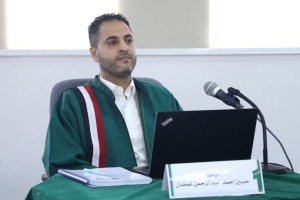
During the symposium, which was moderated by Dr. Abdelhakim Al-Hijri, four research papers were presented examining various political, social, and cultural dimensions of the British colonialization presence in South Yemen.
– In the first paper, Dr. Mahmoud Al-Shaabi reviewed British colonial policies and their impact on Yemen’s social fabric and national identity.
– The second paper, presented by Dr. Amat Al-Ghafour Al-Ameer, addressed repressive measures implemented in Aden and the ways in which the city was used to advance colonial interests.
– Dr. Amat Al-Malik Al-Thawr, in the third paper, focused on Aden’s cultural landscape and the role of cultural and educational institutions in preserving national identity.
– The final paper, delivered by Dr. Mohammed Al-Safi, highlighted examples of national resistance and Yemenis’ efforts in confronting the occupation and advancing the liberation movement.
At the conclusion of the event, participants underscored the importance of preserving national memory, encouraging historical research, and promoting the values of unity and national belonging. They stressed that revisiting such defining historical moments helps strengthen collective awareness and supports building a future grounded in a deep understanding of Yemen’s history and the struggles of its people.


Discover more from Sana'a University
Subscribe to get the latest posts sent to your email.