PhD Degree Awarded to Mr. Abdulsalam Mohammed Hussein in Information Technology
- Categories Letters and Promotions - Graduate Studies, news, Regulations - Postgraduate Studies
- Date February 20, 2026

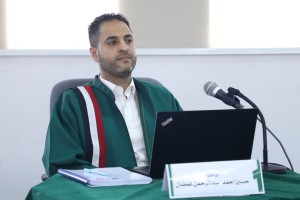
Mr. Abdulsalam Mohammed Hussein Khaqo was awarded a PhD degree in Information Technology for his dissertation titled: Enhancing Asynchronous Advantage Actor-Critic Algorithm for Cybersecurity Intrusion Detection in Edge Computing, which was submitted to the Faculty of Computer and Information Technology – Sana’a University. The dissertation defense was held on Thursday, February 12, 2026.
The PhD Viva-Voce Committee, which was formed based on a resolution issued by the Graduate Studies and Scientific Research Council, consisted of the following:
# Committee Members Designation Position
1 Assoc. Prof. Naji Ali Abdullah Al-Shaibani Internal Examiner Chair
2 Prof. Sharaf Abdulhaq Mahyoub Al-Hamdi Main Supervisor Member
3 Assoc. Prof. Fouad Hassan Mohammed Yahya Abdulrazzaq External Examiner Member
The dissertation aimed to:
Develop adaptive class balancing using Dynamic Synthetic Minority Oversampling combined with Edited Nearest Neighbors (DSMOTEENN) on the X-IIoTID dataset.
Enhance the Worker component in the A3C algorithm to achieve faster convergence, reduced gradient variance, stable updates, and improved parameter synchronization.
Design the hybrid HADT algorithm integrating the enhanced A3C (suitable for continuous-feature attack detection) with Decision Tree (DT) classifiers (effective for discrete-feature attacks).
The study yielded several key findings summarized as follows:
The hybrid model effectively addressed data imbalance using DSMOTEENN, improving rare-class detection and reducing error rates.
The proposed enhancements to A3C within the EA3C model (including gradient stabilization, weighted synchronization, and CNN/FFNN-based feature extraction) achieved faster convergence, greater training stability, and superior generalization compared to baseline models such as DT, DDQN, and AERL.
The HADT algorithm achieved outstanding performance in Industrial IoT intrusion detection, with average Accuracy, Precision, Recall, and F1-Score exceeding 99.8% in both binary and multi-class classification (up to 19 attack classes).
ROC and AUC analyses showed near-perfect discrimination (0.9982–1.0000).
The model demonstrated computational efficiency with reduced training time, suitable inference latency, and optimized energy consumption—making it appropriate for resource-constrained edge computing environments.
The proposed hybrid methodology outperformed traditional and standalone reinforcement learning approaches, establishing a new benchmark in Industrial IoT cybersecurity analytics.
In light of these findings, the researcher recommended the following:
Expanding evaluation across diverse industrial datasets (energy, manufacturing, healthcare) to validate generalizability.
Integrating graph-based deep learning models (e.g., Graph Neural Networks and Graph Attention Networks) for detecting coordinated large-scale attacks.
Exploring advanced reinforcement learning methods such as Proximal Policy Optimization (PPO) and Soft Actor-Critic (SAC).
Incorporating Meta-Reinforcement Learning to enhance rapid adaptation to emerging attack patterns.
Testing the system in real industrial environments with live traffic.
Applying federated learning to enable secure model sharing across distributed edge nodes.
Enhancing interpretability using Explainable AI (XAI) techniques such as SHAP and LIME.
Applying model compression and quantization techniques for deployment on ultra-constrained embedded systems.
Developing distributed Multi-Worker DRL architectures for cooperative defense in large-scale IIoT networks.
Moving toward Multi-Modal Intrusion Detection Systems integrating network flows, device behavior, and sensor data.
The dissertation defense was attended by a number of academics, researchers, and specialists, students, colleagues, and the researcher’s family.


https://youtu.be/nbIIp5dOMd8?si=mc6f03RChjNtQQPo

Previous post
Master's Degree Awarded to Mr. Hamed Khaled Al-Kohlani in Radio and Television
Next post