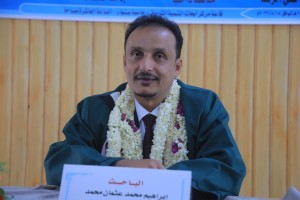
Master’s Degree Awarded to Researcher Ibrahim Askar Yahya Kamel in Dentistry
- Categories Letters and Promotions - Graduate Studies, news, Regulations - Postgraduate Studies
- Date August 21, 2026

Researcher Ibrahim Askar Yahya Kamel was awarded a Master’s Degree in Dentistry for his thesis titled: Evaluation of the Quality of Conventional Implant Impressions in a Sample of Dental Laboratories in Sana’a City, which was submitted to the Department of Conservative Dentistry, Faculty of Dentistry– Sana’a University. The MA defense was held on Monday, August 10, 2026.
The MA Viva-voce Committee, which was formed based on a resolution issued by the Graduate Studies and Scientific Research Council, consisted of the following:
# Committee Members Designation Position
1 Assoc. Prof. Mohsen Ali Yahya Al-Hamzi Internal Examiner Chair
2 Dr. Mohammed Abdulaziz Mansour Al-Baili Main Supervisor Member
3 Assoc. Prof. Mohammed Al-Samhari External Examiner Member
The study aimed to evaluate the quality of conventional dental implant impressions submitted to a sample of dental laboratories in Sana’a City, as well as assess dentists’ knowledge, attitudes, and clinical practices regarding dental implant impression techniques.
The study produced several key findings:
95% of the evaluated impressions contained at least one detectable defect.
Condensation silicone was the most commonly used impression material, while prefabricated plastic impression trays were the most commonly used type of tray.
The rate of critical errors at the finish-line area reached 87%, with impressions taken using the abutment-level technique showing the highest error rates.
66% of the participating dentists reported being unaware of specific techniques for taking dental implant impressions.
Practitioners who were aware of advanced techniques showed a preference for Polyvinyl Siloxane (PVS) and the open-tray technique.
The study revealed a notable gap in dentists’ awareness and in the standardization of clinical protocols for dental implant impression procedures.
The study recommended strengthening educational and training programs for dentists in dental implant impression techniques, implementing stricter quality-control measures in implant-supported prosthodontics, conducting further studies involving larger and more diverse samples to assess the quality of dental implant impressions and the factors affecting them, and standardizing clinical protocols for dental implant impression techniques and materials.
The defense session was attended by a number of academics, researchers, students, and interested participants, as well as the researcher’s colleagues and family members.


Previous post