Master’s Degree Awarded to Mr. Akram Mohammed Al-Khaishni in Translation
- Categories Letters and Promotions - Graduate Studies, news, Regulations - Postgraduate Studies
- Date August 30, 2025

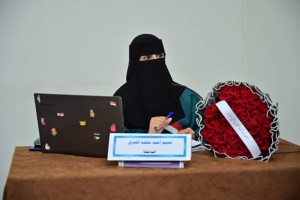
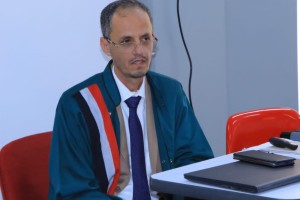
Mr. Akram Mohammed Ali Al-Khaishni was awarded a Master’s degree in Translation with an average of (Excellent) and a grade of (95%) for his thesis titled: Problems Facing Senior Translation Students in Translating Phrasal Verbs in Business Texts from English into Arabic, which was submitted to the Community Center for Translation and Language Teaching – Sana’a University. The MA defense was held on Thursday, August 28, 2025.
The MA Viva-voce Committee, which was formed based on a resolution issued by Graduate Studies and Scientific Research Council, consisted of the following:
| # | Committee Members | Designation | University | Position |
| 1 | Assoc. Prof. Abdulmalik Mansour Saif | External Examiner | Ibb University | Chair |
| 2 | Prof. Abdulhamid Abdulwahid Al-Shuja’a | Main supervisor | Sana’a University | Member |
| 3 | Dr. Abdulwadood Ahmed Abdu Annuzaili | Internal Examiner | Sana’a University | Member |
The thesis aimed to:
- Investigate the problems encountered by translation students when translating phrasal verbs in business texts from English into Arabic.
- Identify the strategies employed by students in translating linguistic structures of such phrasal verbs.
- Explore the underlying causes of the difficulties hindering the translation of such phrasal verbs.
The study yielded a number of findings summarized as follows
- The most prominent challenges lay in translating idiomatic phrasal verbs, due to their significant departure from literal meanings.
- Students showed a tendency to rely on literal translation, even in contexts where it proved inaccurate.
- The study attributed these challenges to insufficient practical training, inadequate attention to phrasal verbs in curricula, and limited exposure to appropriate translation strategies.
The researcher presented several recommendations, including:
- Incorporating specialized modules within translation programs to provide in-depth instruction on phrasal verbs.
- Training students in diverse strategies such as semantic equivalence, paraphrasing, and borrowing, to reduce excessive reliance on literal translation.
- Encouraging further research on the translation of phrasal verbs in other specialized domains, such as legal, medical, and technical translation.
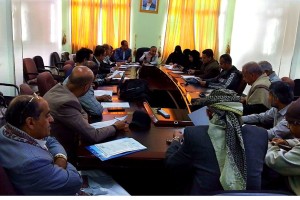
The defense was attended by a number of academics, researchers, interested participants, colleagues, and the researcher’s family members.


[/embed]
Discover more from Sana'a University
Subscribe to get the latest posts sent to your email.