PhD Degree Awarded to Mr. Fawaz Hassan Al-Hayyani in Ancient Archaeology
- Categories Letters and Promotions - Graduate Studies, news, Regulations - Postgraduate Studies
- Date September 9, 2025

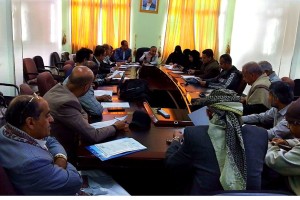
Mr. Fawaz Hasan Ameer Al-Hayyani was awarded a PhD degree in Ancient Archaeology for his dissertation titled: A Study of Archaeological Sites in Dhamri Region through Archaeological Remains and Inscriptions, which was submitted to the Department of Archaeology and Tourism, Faculty of Arts and Humanities – Sana’a University. The dissertation defense was held on Wednesday, August 27, 2025.
The PhD Viva-Voce Committee, which was formed based on a resolution issued by the Graduate Studies and Scientific Research Council, consisted of the following:
| # | Committee Members | Designation | University | Position |
| 1 | Prof. Abdulhakim Shaif Mohammed | Internal Examiner | Sana’a University | Chair |
| 2 | Prof. Mohammed Saad Al-Qahtani | Main Supervisor | Sana’a University | Member |
| 3 | Prof. Munir Abduljaleel Al-Ariqi | External Examiner | Thamar University | Member |
The dissertation was a descriptive and comparative archaeological study of several sites in Dhamri region, historically known as Abwan (currently Qasr Al-Sabaya), Nakbam (currently Hisn Jashayesh), Al-Ahjer Al-Qadim (Bani Bada), Ta’arman (currently Bayt Dhiba’an), Bani Hayyan, and Bayt Abu Atif. Dhamri region lies south of Sana’a and north of Dhamar city. It is administratively divided between Al-Hada’a District of Dhamar Governorate and Bilad Al-Rus District of Sana’a Governorate.
The study aimed to uncover the archaeological sites and identify the material remains and physical evidence they contain. A key objective was to produce a scientific and historical record that sheds light on Dhamri in its northern (Al-Jarti) and southern (Al-Dharanhi) sectors. It also sought to systematically study and survey all the archaeological sites in the region.
The dissertation examined six archaeological sites— Abu’an, Nakbam, Al-Ahjer Al-Qadim, Ta’arman, Bani Hayyan, and Bayt Abu Atif—with a focus on highlighting their layouts, which include fortifications, palaces, temples, and surrounding architectural structures and annexes, such as public and private dwellings, water facilities, rock-cut tombs, roads, and other features.
The study yielded several key findings summarized as follows:
- The archaeological remains at the sites reflect highly sophisticated technical and architectural achievements, suggesting their status as principal centers of significance.
- A unique moating feature distinguished Al-Ahjer Al-Qadim site: a surrounding rock-cut moat (5.5 meters deep) around what became known as Qasr Al-Mukhandaq (Moated Palace).
- At Ta’arman site, a rare bronze statue was uncovered depicting a woman wearing a royal crown, holding a cornucopia in her left hand, dressed in a transparent garment with a belt at the waist, and adorned with a necklace ending in a sun disk and dangling on her chest.
- At Bani Hayyan site, several ancient Yemeni inscriptions, graffiti, and ibex engravings were found, including five inscriptions (Hayyani 1–5), which, after study, found to address religious and commemorative themes.
The researcher concluded his study with several key recommendations, including:
- Conducting further archaeological research and documentation of the region’s sites before their damage or destruction.
- Remove debris and rubble from the surface of the sites, left by random digging and
- Undertake systematic and scientifically guided archaeological excavations at Dhamri sites to preserve and study their cultural heritage.
The dissertation defense was attended by a number of academics, researchers, specialists, students, colleagues, and the researcher’s family.


[/embed]
Discover more from Sana'a University
Subscribe to get the latest posts sent to your email.

Previous post
Master's Degree Awarded to Ms. Mounia Shamsher from Faculty of Dentistry
Next post